
Last updated: June 9, 2026
Bone takes months to fuse, not weeks. That single fact reshapes almost every honest conversation I have with patients about spinal fusion recovery, because the marketing brochures and the biology rarely tell the same story.
Quick Answer
Spinal fusion recovery is a staged process measured in months, not weeks. Most patients walk within 24 hours, manage daily activities by 6 weeks, and feel "mostly normal" between 3 and 6 months. However, the bony fusion itself usually consolidates over 6 to 12 months, and full neurological and functional recovery can take up to a year or more. Outcomes depend on the level fused, your overall health, smoking status, and how carefully you follow rehabilitation guidance.
Key Takeaways
- Walking starts on day 1; driving usually returns at 2 to 6 weeks; desk work at 4 to 8 weeks.
- Bone fusion is biological, not surgical magic, and typically takes 6 to 12 months to consolidate.
- Smoking, diabetes, obesity, and long-term steroid use are the biggest modifiable risks for delayed or failed fusion.
- Physiotherapy usually starts at 4 to 6 weeks and continues for several months.
- Adjacent-segment problems are a long-term consideration, not an immediate one.
- A second opinion before surgery is reasonable for almost any elective fusion.
- Pain at 3 months that is improving is normal; pain that is worsening needs urgent review.
How long does it really take to recover from spinal fusion surgery?
Honest answer: full spinal fusion recovery typically runs 6 to 12 months, with meaningful improvement often continuing into the second year. The hospital stay is short. The biology is not.
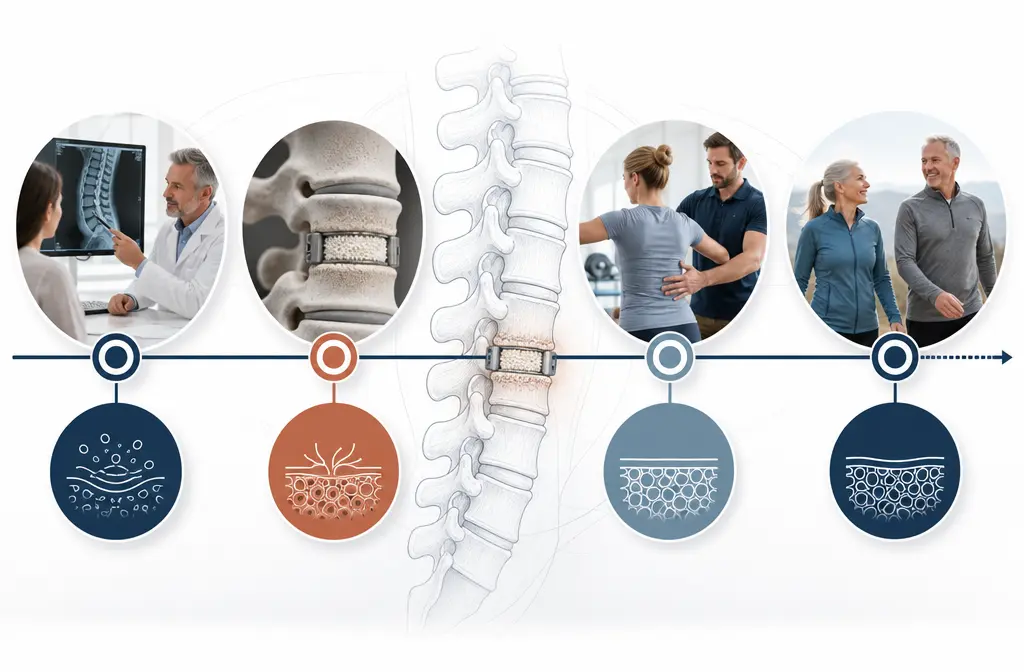
Here's the realistic timeline I share with patients I review online:
These are averages. A single-level lumbar fusion in a healthy 40-year-old is not the same recovery as a three-level fusion in a 70-year-old with diabetes.
What are the typical restrictions after spinal fusion?
Most surgeons use a "BLT" rule for the first 6 to 12 weeks: no Bending, Lifting (more than around 4 to 5 kg), or Twisting. These restrictions protect the hardware while bone bridges the fused segment.
Common early restrictions include:
- No driving until off strong opioids and able to perform an emergency stop (usually 2–6 weeks).
- No lifting heavier than a kettle or small shopping bag for 6 weeks.
- No prolonged sitting beyond 30–45 minutes without standing up.
- No swimming or submerging the wound until fully healed (typically 3–4 weeks).
- No high-impact activity (running, contact sport) until cleared, usually after 3–6 months.
Restrictions vary by surgeon and by the type of fusion. Ask for written guidance specific to your operation.
How painful is spinal fusion recovery week by week?
Honestly, the first 2 weeks are the hardest, and pain then improves in a non-linear pattern. Many patients describe a clear step-down at around weeks 2, 6, and 12.
A rough pain pattern most of my patients describe:
- Week 1: Sharp incisional and muscular pain; opioids commonly needed.
- Week 2–3: Pain shifts to deep aching and stiffness; opioids tapering.
- Week 4–6: Mostly muscular discomfort; nerve symptoms (if present preoperatively) often still settling.
- Week 6–12: "Good days" outnumber "bad days"; flare-ups after activity are normal.
- Month 3–6: Pain that remains is usually mild and activity-related.
A flare-up at week 8 does not mean failure. New leg weakness, fever, wound discharge, or pain that escalates rather than fluctuates does need urgent review.
What activities can I not do after spinal fusion?
In the first 3 months, avoid bending forward from the waist, twisting the trunk, and lifting anything heavier than light household items. Many patients also need to avoid sitting for long periods, long car journeys, and lying flat on a very soft mattress.
Longer-term restrictions are more individualised. After fusion has consolidated, most people can return to:
- Walking, cycling, swimming, and most gym work
- Office work and most manual jobs
- Yoga and Pilates, with modifications around the fused segment
- Most recreational sport
Activities I usually advise long-term caution with: heavy axial loading (such as competitive powerlifting), high-impact contact sport, and repetitive heavy manual labour without proper technique. These are not absolute bans, but they raise the load on segments above and below the fusion.
Average cost of spinal fusion surgery and recovery
Costs vary widely by country, hospital, implant choice, and number of levels fused. I will not quote figures that pretend to be universal. As a general framework:
- In many European public systems (UK NHS, Germany statutory insurance), the procedure is covered with little direct cost to the patient.
- In private systems and self-pay contexts, single-level lumbar fusion is often quoted in the range of several tens of thousands of euros, pounds, or dollars.
- Indirect costs (time off work, physiotherapy, equipment, home help) are frequently underestimated and can equal or exceed the surgical fee.
Before committing, ask for an itemised written quote that includes implants, anaesthesia, hospital stay, follow-up imaging, and post-operative physiotherapy.
How do different types of spinal fusion impact recovery time?
The approach and number of levels significantly change the recovery curve. A single-level ALIF or minimally invasive TLIF in a healthy adult is a very different operation from a long posterior thoracolumbar fusion for deformity.
Rough comparisons I use when counselling patients:
- Cervical (ACDF, 1–2 levels): Often the "easiest" recovery; many return to desk work in 2–4 weeks.
- Single-level lumbar fusion (TLIF/PLIF/ALIF): Desk work 4–8 weeks; meaningful recovery 3–6 months.
- Multi-level lumbar fusion: Add several weeks at each stage; full recovery often 9–12+ months.
- Long deformity correction (scoliosis): Recovery measured in 12+ months, with a longer rehab arc.
- Minimally invasive vs open: MIS techniques can reduce early pain and blood loss but the bone biology of fusion is the same.
What complications should I watch for during spinal fusion recovery?
Most fusions heal without major issues, but every patient should know the warning signs. Call your surgical team urgently if you notice:
- Fever above 38°C, chills, or feeling systemically unwell
- Increasing redness, swelling, warmth, or discharge from the wound
- New or worsening leg/arm weakness or numbness
- Loss of bladder or bowel control, or numbness around the groin (possible cauda equina)
- Severe calf pain or swelling (possible DVT)
- Sudden chest pain or breathlessness
Longer-term issues include pseudarthrosis (failure of bone to fuse), hardware-related pain, and adjacent-segment degeneration, where the disc above or below the fusion wears more quickly because it now carries extra load. The reported rates of clinically significant adjacent-segment disease vary in the literature; it is a real consideration, particularly for younger, active patients, and one I always discuss before recommending fusion.
"Fusion is not undoing the problem. It is locking a painful segment and asking the rest of your spine to compensate. That trade-off must be worth it."
Tips for managing pain and mobility after spinal fusion
Lead with movement, sleep, and a stepped-down medication plan. The patients who do best treat recovery like training, not waiting.
Practical strategies:
- Walk every day, multiple short walks rather than one long one. Movement reduces stiffness and lowers DVT risk.
- Use ice for the first 72 hours, then alternate ice and gentle heat as muscle spasm becomes the dominant symptom.
- Sleep on your side with a pillow between the knees, or on your back with a pillow under the knees.
- Taper opioids deliberately with your team; long opioid use is linked with worse functional outcomes.
- Protect the bone: stop smoking, control blood sugar, eat adequate protein, and keep vitamin D in range.
- Pace activity: do slightly less on a "good day" than you feel you could, to avoid the boom-and-bust cycle.
How long before I can return to work after spinal fusion?
Most desk workers return to work in 4 to 8 weeks; manual workers usually need 3 to 6 months, sometimes longer. The number of levels fused, your job demands, and how your employer handles graded return all matter.
A reasonable framework:
- Sedentary office work: 4–8 weeks, often part-time first.
- Light manual or standing work: 8–12 weeks.
- Heavy manual work (lifting, scaffolding, nursing with patient handling): 4–6 months minimum, with reassessment.
Returning too early is one of the more common regrets I hear in follow-up consultations.

Best exercises and physical therapy for spinal fusion recovery
Structured physiotherapy usually begins around 4 to 6 weeks and focuses on three things in sequence: walking tolerance, core and hip stability, then graded strengthening. Earlier than that, the priority is walking and gentle range of motion.
A typical progression:
- Weeks 0–6: Walking, breathing exercises, gentle ankle and hip movements, posture awareness.
- Weeks 6–12: Pelvic tilts, glute bridges, dead-bug, bird-dog, stationary cycling, light hydrotherapy if available.
- Months 3–6: Progressive resistance training, hip hinge re-education, balance work, return to gym with guidance.
- Months 6–12: Sport-specific or job-specific conditioning.
Work with a physiotherapist experienced in spinal surgery rehabilitation, ideally one your surgeon recommends.
What age groups handle spinal fusion recovery best?
Generally, patients in their 30s to 50s recover fastest, but motivation and overall health matter more than age alone. I have seen fit 70-year-olds outpace deconditioned 45-year-olds.
What matters more than the number on your passport:
- Cardiovascular fitness and muscle mass
- Smoking status (this is the single biggest modifiable factor)
- Diabetes control
- Bone density (especially in post-menopausal women)
- Mental health and social support
For older patients, the trade-off discussion shifts: shorter expected exposure to adjacent-segment problems, but slower wound and bone healing.
Common mistakes people make during spinal fusion rehabilitation
The biggest mistakes I see are doing too much in the first month, doing too little after the third month, and continuing to smoke. All three quietly sabotage outcomes.
Recurring patterns to avoid:
- Skipping walks in the first 2 weeks because "it hurts" — gentle walking is treatment, not optional.
- Lifting grandchildren, shopping, or laundry baskets at week 3 because you "feel fine."
- Abandoning physiotherapy at 3 months when pain is mostly gone but strength is still 30–40% down.
- Comparing your recovery to a friend's or an online story; almost no two fusions are identical.
- Not getting a second opinion before agreeing to surgery, especially for elective degenerative cases. An independent online second opinion is straightforward to arrange and can either confirm the plan or open up non-surgical options.
FAQ
Is spinal fusion recovery worth it?
For the right indication (instability, deformity, severe nerve compression with structural cause), most patients report meaningful improvement. For axial back pain alone without clear structural cause, evidence is more mixed, and a second opinion is particularly valuable.
When does the bone actually fuse?
Clinically, most fusions are considered solid between 6 and 12 months on imaging. Some take longer, especially in smokers or multilevel cases.
Will I set off airport security?
Modern titanium implants rarely trigger alarms, but it can happen. You don't generally need a card, though some patients carry a brief operative summary when travelling.
Can I have an MRI later?
Yes. Modern spinal implants are MRI-compatible, though image quality near the hardware can be reduced.
What's the risk of needing another operation?
Reoperation rates vary by indication and follow-up length. Adjacent-segment problems are the most common long-term reason. Your surgeon should give you a realistic figure for your specific case.
Should I get a second opinion before fusion?
For almost any elective fusion, yes. Online second opinions allow an independent spine surgeon to review your imaging and history without pressure, and often clarify whether fusion is the best option for you.
Conclusion
Spinal fusion recovery is honest work. The operation itself is a few hours; the biology that follows is a few seasons. If you set expectations around months rather than weeks, protect the bone by not smoking and by following the BLT rules, and commit to graded rehabilitation, you give yourself the best chance of a good outcome — without anyone needing to promise one.
If you are still weighing up whether surgery is the right answer, getting an independent online second opinion before committing is a reasonable, low-risk step. This article is educational and not a substitute for in-person assessment by your treating team.