

Last updated: June 19, 2026
Roughly one in three spine surgery recommendations changes after an independent review. That figure, drawn from second-opinion programmes published in peer-reviewed journals, isn't a scandal — it's a reflection of how nuanced cervical spine care really is. As a board-certified, DWG-certified spine surgeon based in Stolberg, Germany, I review cervical MRIs from patients around the world every week, and I can tell you plainly: getting a second opinion before neck surgery is not a sign of distrust. It's a sign of due diligence on a decision that, once made, is difficult to reverse.
Quick Answer
A second opinion before neck surgery is a structured review of your diagnosis, imaging, and proposed procedure by an independent spine specialist who has no stake in operating on you. It's most valuable when surgery is elective (not emergency), when the symptoms are pain-predominant rather than progressive neurological loss, and when alternatives such as physiotherapy, injections, or motion-preserving surgery haven't been clearly discussed. An online review typically takes 5–10 working days and can confirm, refine, or challenge the original plan.
Key Takeaways
- A second opinion is most useful for elective cervical procedures like ACDF or disc replacement, not for emergencies with cord compression or rapidly progressing weakness.
- Studies of second-opinion programmes consistently show meaningful changes in diagnosis or treatment plan in a substantial minority of cases.
- ACDF, cervical disc arthroplasty, and structured conservative care each have evidence-based indications — the "right" choice depends on your anatomy, age, and symptoms.
- Online second opinions usually require your MRI (on disc or via secure upload), a clinical summary, and a list of your symptoms and prior treatments.
- An independent reviewer should never pressure you toward surgery they would perform themselves.
- Red flags for needing a second opinion include rushed consultations, no discussion of non-surgical options, or a single imaging finding driving a major surgical plan.
- Recovery, risks, and success rates vary by procedure — clarity on these numbers is part of true informed consent.
What is a second opinion before neck surgery, and who is it for?
A second opinion before neck surgery is an independent review by a spine specialist (neurosurgeon or orthopaedic spine surgeon) who evaluates your imaging, history, and the recommended procedure to confirm whether surgery is appropriate and whether the chosen technique is the best fit. It's for any patient facing elective cervical spine surgery — including ACDF (anterior cervical discectomy and fusion), cervical disc arthroplasty, posterior foraminotomy, or laminoplasty — who wants confirmation before committing.
It's particularly valuable if:
- You've been offered surgery after a single consultation.
- Your main symptom is neck or arm pain without major weakness.
- You haven't completed a structured course of physiotherapy.
- You're young and fusion has been recommended without discussing disc replacement.
- The surgeon hasn't clearly explained alternatives.
It's less critical (though still reasonable) when there's clear, progressive myelopathy, significant motor weakness, or signs of spinal cord compression that genuinely require timely surgical decompression.
When should I definitely get a second opinion for neck surgery?
Get a second opinion whenever surgery is elective and the decision isn't time-critical. Specifically, seek one if any of the following apply:
- Surgery was recommended at the first visit without a trial of conservative care lasting at least 6–12 weeks (assuming no red-flag neurology).
- Fusion was proposed but motion-preserving options (cervical disc arthroplasty) weren't discussed.
- You have mainly axial neck pain without clear radiculopathy or myelopathy — outcomes for surgery in pure axial neck pain are less predictable.
- Imaging findings don't match your symptoms (for example, a left-sided disc bulge but right-sided arm pain).
- Multi-level surgery is proposed — every added level increases risk and reduces motion.
- You feel rushed, dismissed, or pressured.
When to skip the wait: acute, severe, progressive neurological deficits (worsening hand clumsiness, gait disturbance, bowel or bladder symptoms) warrant urgent in-person evaluation rather than a leisurely online review.
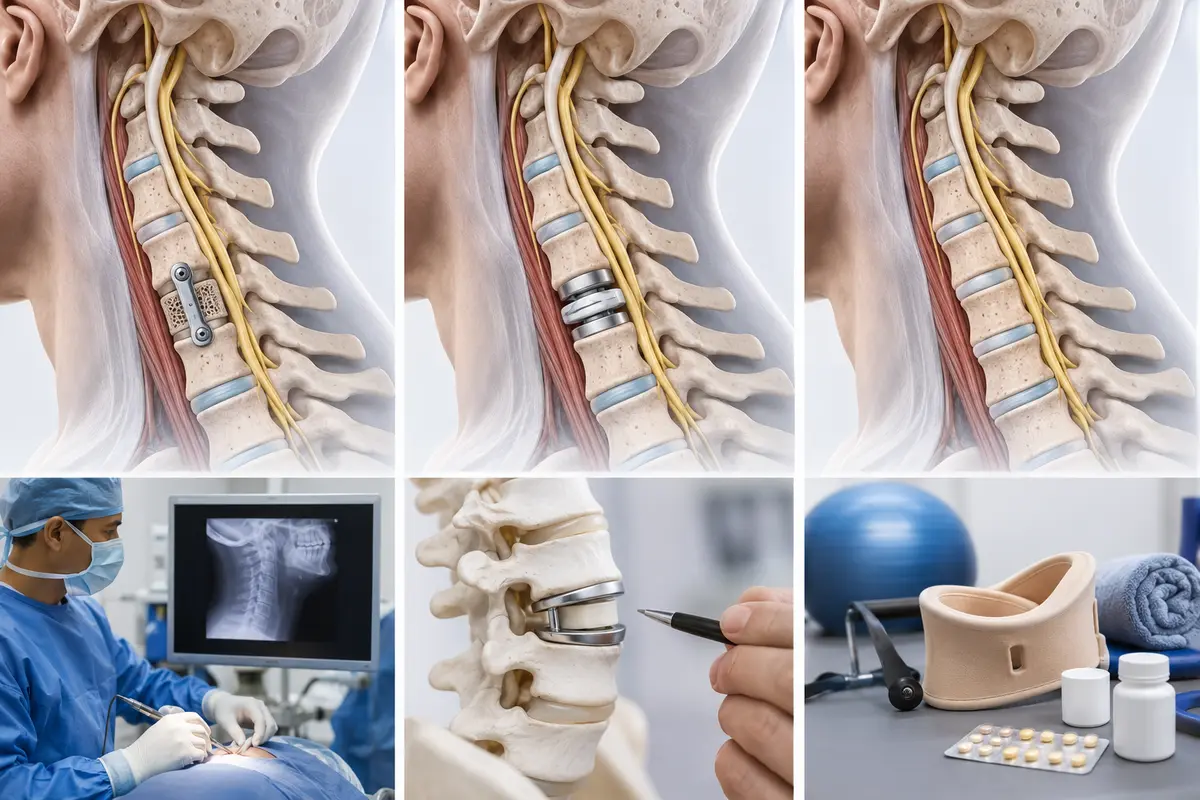
ACDF vs cervical disc replacement vs conservative care: how do they compare?
The three main pathways for cervical radiculopathy or myelopathy each have a place. The right choice depends on your age, the number of levels involved, disc height, facet joint condition, and whether the spinal cord or nerve roots are compressed.
Randomised trials and long-term follow-up studies published in journals indexed on PubMed have shown that, in carefully selected patients, cervical disc arthroplasty produces outcomes at least equivalent to ACDF, with the potential advantage of preserved motion. That said, ACDF remains a reliable, well-studied operation with decades of evidence behind it. Neither is universally "better" — the question is which fits your specific anatomy.
A genuine second opinion before neck surgery should explain why one of these three pathways is recommended over the others, not just default to the surgeon's preferred technique.
What are the risks of neck surgery, and what complications are most common?
All cervical spine surgery carries risk. Honest informed consent means knowing these numbers, not just being told "it's very safe." Reported risks from systematic reviews and registry data include:
- Dysphagia (swallowing difficulty): common in the first weeks after anterior approaches, usually temporary.
- Hoarseness or voice change: from recurrent laryngeal nerve irritation, usually transient.
- Dural tear and CSF leak: uncommon but possible.
- Infection: low, generally under 1–2% for elective cervical procedures.
- Hardware failure or non-union (pseudarthrosis): more common in smokers and multi-level fusions.
- Adjacent segment disease: progressive degeneration above or below a fusion over years.
- Neurological injury: rare but serious; includes nerve root or spinal cord injury.
- Vascular injury: rare, related to vertebral artery in posterior approaches.
These are not reasons to refuse appropriate surgery. They are reasons to be sure surgery is the right answer for you.
Am I a good candidate for neck surgery, or might I not need it?
You're more likely to benefit from cervical surgery if you have: a clear structural cause on imaging (disc herniation, stenosis, spondylotic myelopathy), symptoms that match the imaging, persistent or progressive neurological signs, and failure of well-conducted conservative care for radiculopathy.
Signs you may not need surgery — or at least not yet:
- Pain only, with no arm symptoms, weakness, or reflex changes.
- Imaging shows mild changes typical for your age (degenerative findings are common in asymptomatic adults over 40, as demonstrated in MRI cohort studies).
- You haven't tried structured physiotherapy, postural rehabilitation, or a short course of appropriate medication.
- Symptoms are improving, even slowly.
- The proposed surgery is multi-level for what sounds like single-level symptoms.
Degenerative changes on a cervical MRI are extraordinarily common in people without any neck pain at all. An MRI finding alone is not a diagnosis — it must be correlated with your clinical picture.
What alternative treatments to neck surgery should I try first?
For most cervical radiculopathy without significant weakness or myelopathy, guidelines from bodies such as NICE and the North American Spine Society support an initial trial of non-operative care. Evidence-based options include:
- Structured physiotherapy focused on cervical and scapular stabilisation, posture, and graded loading.
- Short-course oral medication (NSAIDs, neuropathic pain medication where appropriate).
- Activity modification rather than prolonged immobilisation or rest.
- Image-guided cervical epidural or selective nerve root injections in selected cases.
- Ergonomic and workplace assessment, particularly for desk-based workers.
- Manual therapy by appropriately trained clinicians, used cautiously in the cervical spine.
Cochrane reviews of conservative cervical care show modest but real benefits for many patients, and many improve over 6–12 weeks. If symptoms are stable or improving, time is often on your side.
How do I find a good neurosurgeon or spine surgeon for a second opinion?
Look for an independent specialist who: is board-certified in neurosurgery or orthopaedic spine surgery, performs cervical spine surgery regularly, has no financial relationship with your first surgeon, and is willing to recommend non-surgical care when appropriate.
Practical filters:
- Check national specialist registers (for example, the General Medical Council in the UK, or equivalent national bodies; in Germany, look for DWG certification).
- Prefer reviewers who practise both ACDF and cervical disc arthroplasty — they're less likely to be biased toward one technique.
- Ask whether they routinely recommend conservative care.
- Read their written reports, not just marketing pages.
An online second-opinion service can be a sensible option if local independent expertise is limited, you live in a small region, or you want a reviewer who has no professional overlap with your treating team.
How does an online second opinion work, and what records do I need?
An online second opinion is a structured remote review of your imaging and clinical history, delivered as a written report (sometimes with a video consultation). It does not replace in-person examination — but for a well-documented cervical case, it can clarify whether the recommended surgery is reasonable.
Typical steps:
- You submit a clinical summary, symptoms, and treatment history.
- You upload your cervical MRI (DICOM files, not just the radiology report) and any X-rays or CTs.
- The surgeon reviews the imaging directly, not just the report.
- A written opinion is provided, often within 5–10 working days.
- A follow-up video call may be offered to discuss the findings.
Records to prepare:
- Full cervical MRI on disc or as DICOM upload (the actual images, not screenshots).
- Any cervical X-rays, including flexion-extension views if performed.
- Radiology reports.
- A summary of symptoms with timeline.
- List of treatments tried (physio, medication, injections).
- The written surgical recommendation, if available.
- Relevant medical history and current medications.

What questions should I ask during a neck surgery consultation?
Bring a written list. Specific, useful questions include:
- What exactly is my diagnosis, and how confident are you in it?
- Which symptoms do you expect surgery to improve, and which may not change?
- Why this procedure rather than disc replacement, fusion, or posterior approach?
- How many of these procedures do you perform each year?
- What are your personal complication and revision rates?
- What happens if I wait three to six months?
- What non-surgical options haven't I tried yet?
- What's the realistic recovery timeline and return to work?
- What would change your mind about operating?
If the answers are vague or impatient, that's important information.
How long is neck surgery recovery, and what are the success rates?
Recovery varies by procedure. For single-level ACDF or cervical disc arthroplasty, many patients return to desk work within 2–4 weeks and to most normal activity by 6–12 weeks, with bony fusion (in ACDF) typically maturing over 3–6 months. Multi-level surgery and posterior procedures generally involve longer recovery.
Published outcome data for properly selected patients suggest:
- Arm pain relief after cervical decompression (ACDF or CDA) is generally good — often reported around 80–90% improvement in well-selected radiculopathy.
- Neck pain relief is more variable and harder to predict.
- Myelopathy outcomes depend on how long symptoms have been present and how severe they are at surgery.
These are population averages, not promises. Individual results depend on diagnosis accuracy, surgical technique, your overall health, smoking status, and rehabilitation.
What about cost and insurance coverage for a second opinion?
Costs vary widely by country and provider. Many national health systems and private insurers recognise the value of second opinions before elective spine surgery, and some cover them in full or in part. Online second opinions are typically offered as a fixed fee, which can be lower than an in-person specialist consultation when travel is factored in. I won't quote specific figures here because they shift constantly and differ by jurisdiction; check directly with the provider and your insurer before booking.
FAQ
Is it rude to get a second opinion before neck surgery?
No. Reputable surgeons expect and welcome second opinions for elective spine surgery. If a surgeon discourages one, that itself is a reason to seek one.
Can an online second opinion really replace an in-person visit?
Not entirely. It can confirm or challenge the proposed plan based on imaging and history, but in-person examination remains important, especially when neurological signs need to be assessed directly.
How quickly do I need to decide on neck surgery?
For most elective cervical cases, taking a few weeks to review options is safe. Urgent decisions are typically reserved for progressive myelopathy or significant motor weakness.
Will a second opinion delay my surgery too long?
A well-organised online review takes 5–10 working days. For elective cases, this rarely affects outcomes.
What if the second opinion disagrees with my surgeon?
That's useful information. You can share the report with your original surgeon, ask both to explain their reasoning, or seek a third opinion. The goal is clarity, not conflict.
Do I need a second opinion if I trust my surgeon?
Trust is important, but independent review is about the decision, not the relationship. Even excellent surgeons can disagree about the best approach.
Conclusion: Take the time, ask the questions
Cervical spine surgery, when correctly indicated, can transform quality of life. Done for the wrong reasons or with the wrong technique, it's hard to undo. A second opinion before neck surgery is one of the most practical steps you can take to protect yourself — not because surgeons are untrustworthy, but because medicine is genuinely complex and reasonable specialists can disagree.
Practical next steps:
- Gather your imaging (DICOM files, not just reports) and a clear symptom timeline.
- Write down your questions before any consultation.
- Ask your current surgeon directly about alternatives, including disc replacement and structured conservative care.
- Seek an independent review — locally if possible, online if not — from a surgeon with no stake in operating on you.
- Make your decision when you feel informed, not pressured.
This article is educational and not a substitute for personal medical advice. If you have progressive neurological symptoms, please seek in-person evaluation promptly.