
Last updated: June 12, 2026
Quick Answer
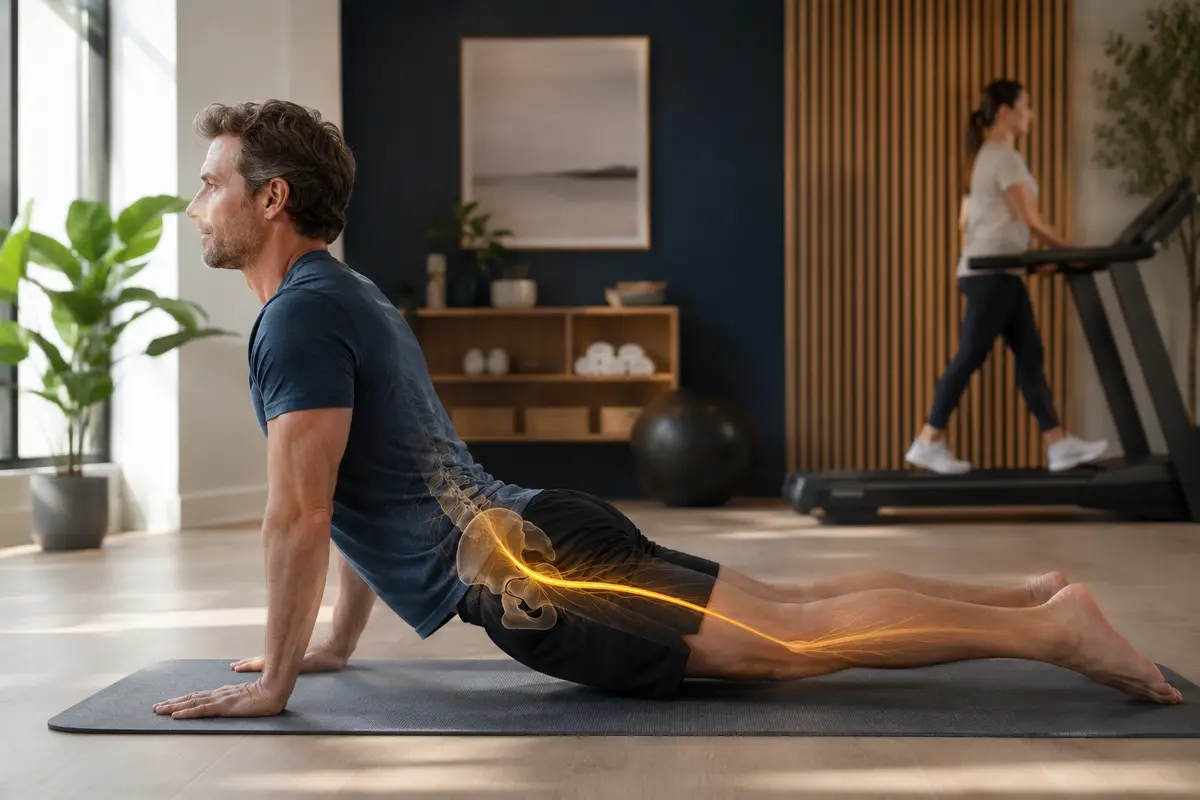
The best sciatica exercises for most people are gentle lumbar extensions (McKenzie press-ups), nerve glides, hip and piriformis stretches, and graded walking. The single most important rule is centralisation: if a movement pulls pain back towards your spine and away from your leg, keep doing it. If it pushes pain further down the leg, stop. Avoid deep seated forward bends, heavy loaded flexion, and prolonged sitting during a flare. None of this replaces an in-person assessment, especially if you have weakness, numbness in the saddle area, or bladder changes.
Key Takeaways
- Sciatica is a symptom, not a diagnosis. Around 85–90% of cases settle without surgery within 6–12 weeks (NICE NG59).
- The centralisation rule is your best home guide: pain moving up and in is good, pain moving down the leg is a warning.
- McKenzie extension exercises, nerve glides, and walking are the safest starting points for most disc-related sciatica.
- Deep seated forward folds, heavy deadlifts, and long sitting sessions often make disc-related sciatica worse.
- Most people notice some change within 2–4 weeks of consistent, correctly performed exercise.
- Red flags (saddle numbness, new bladder or bowel changes, progressive leg weakness) mean stop exercising and seek urgent assessment.
- An independent second opinion is worth considering before any elective spine surgery decision.
What exactly is sciatica and why does it hurt so much
Sciatica is pain that travels along the path of the sciatic nerve: from the lower back or buttock, down the back of the thigh, and sometimes into the calf or foot. It hurts because a nerve root in the lumbar spine is being irritated, compressed, or chemically inflamed, most often by a herniated disc, but sometimes by a tight piriformis muscle, spinal stenosis, or degenerative changes.
The pain feels sharp, electric, or burning because nerves don't ache the way muscles do. They fire. When a nerve root is inflamed, even small movements can trigger that signal down the entire leg. The good news: nerve tissue is resilient. With the right load and the right exercises, irritation usually settles.
How do I know if my back pain is really sciatica
True sciatica typically follows a clear nerve path down one leg, often below the knee, and may come with tingling, numbness, or weakness in specific areas (for example, the big toe or the outer foot). Pain confined to the lower back or buttock alone is usually not sciatica, even if it's severe.
Quick self-check:
- Does the pain travel below the knee on one side? Likely sciatica.
- Does coughing, sneezing, or sitting make the leg pain worse? Classic disc-related sciatica.
- Is there numbness or weakness in the foot? See a clinician for a proper neurological exam.
- Is the pain only in the buttock and worsened by sitting on hard surfaces? Possibly piriformis-related.
A clinical examination, and sometimes MRI, confirms the cause. Imaging alone is not the answer: many people without symptoms have disc bulges on scans.
Which stretches and sciatica exercises work best for sciatic nerve pain
For most disc-related sciatica, four categories work best: lumbar extension, nerve glides, hip openers, and walking. Start gently, stay within tolerable discomfort, and follow the centralisation rule.
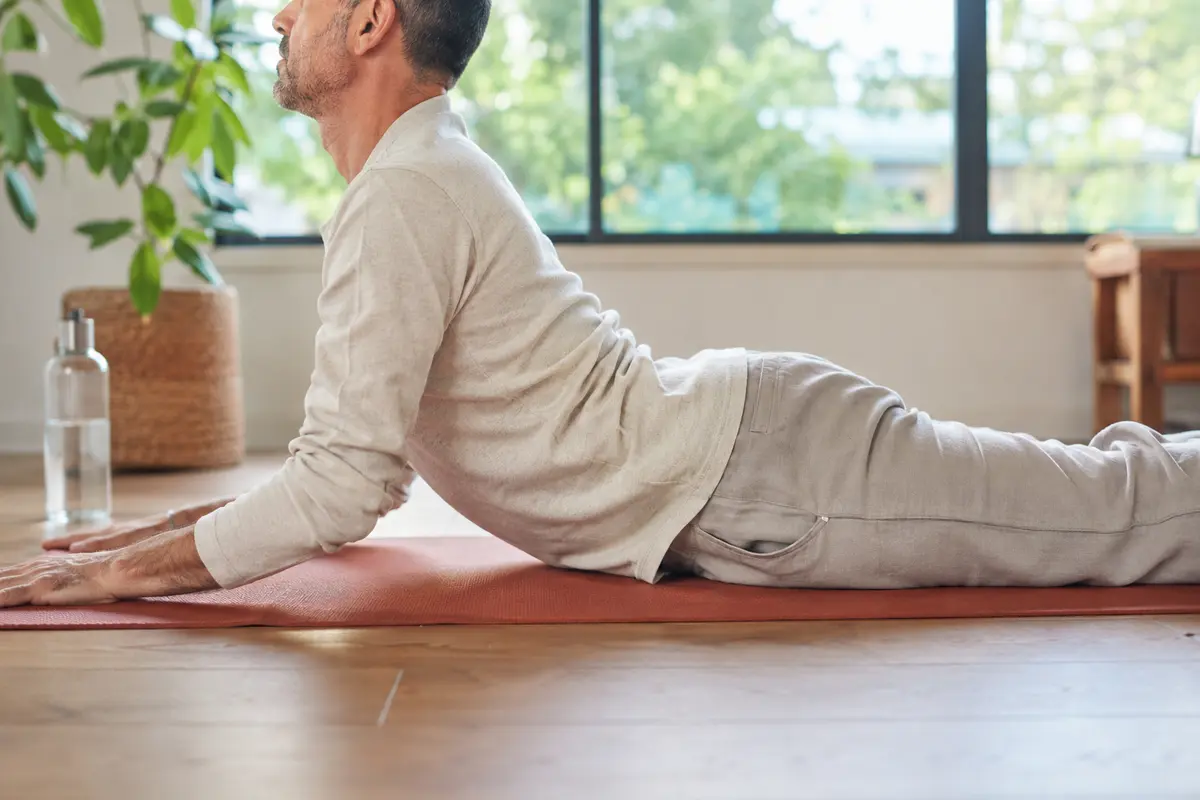
1. McKenzie press-up (prone extension)
Lie face down. Place hands under shoulders. Slowly press the upper body up, keeping the hips on the floor. Hold 2 seconds, lower. Repeat 10 times, several sets per day. If leg pain reduces or moves up towards your back, this is your exercise.
2. Sciatic nerve glide ("flossing")
Sit upright. Straighten the affected leg while looking up and tilting your head back. Lower the leg while tucking your chin. This slides the nerve gently rather than stretching it. Do 10 slow reps, 2–3 times daily. Stop if symptoms worsen.
3. Piriformis stretch (figure-four)
Lie on your back, knees bent. Cross the affected ankle over the opposite knee. Gently pull the uncrossed thigh towards your chest. Hold 30 seconds. Best for buttock-dominant pain.
4. Walking
Underrated and powerful. Start with 5–10 minutes, several times a day, on flat ground. Walking encourages gentle movement around the nerve roots and helps reduce inflammation and stiffness.
The centralisation rule: the single most important principle
Centralisation means pain retreating from the leg and concentrating closer to the spine. This is a good sign, even if the back feels temporarily more sore. Peripheralisation means pain spreading further down the leg. This is a warning.
Use this rule for every exercise:
| Response to exercise | What it means | What to do |
|---|---|---|
| Leg pain reduces or moves up | Centralisation | Continue the exercise |
| Back ache increases but leg improves | Often acceptable | Continue cautiously |
| Leg pain increases or spreads down | Peripheralisation | Stop, modify, or seek advice |
| New numbness or weakness | Red flag | Stop and consult a clinician |
Can yoga help with sciatica or will it make it worse
Yoga can help, but only certain poses. Gentle backbends (cobra, sphinx), cat-cow, and supported child's pose are usually safe. Deep forward folds (seated forward bend, standing toe touches) and twists often aggravate disc-related sciatica because they load the disc in flexion.
If your sciatica comes from a herniated disc, treat flexion-based yoga the same way you'd treat a sprained ankle on a trampoline: not yet.
Choose a teacher who understands therapeutic adaptations, and skip any pose that increases leg symptoms. Yoga is not a substitute for targeted rehabilitation in acute sciatica.

How long should I do these exercises before seeing improvement
Most people notice some change within 2–4 weeks of consistent, daily practice. Full recovery from a sciatic episode commonly takes 6–12 weeks. NICE guidance (NG59) supports this natural-history timeline for most non-surgical cases.
A realistic timeline:
- Week 1: Pain may fluctuate. Focus on finding which exercise centralises symptoms.
- Weeks 2–4: Leg pain typically reduces in intensity or area.
- Weeks 4–8: Strength, tolerance for sitting, and walking distance improve.
- Weeks 8–12: Most return to normal activity. Some residual tingling can persist longer and usually fades.
If there's zero improvement after 4–6 weeks of correctly performed exercises, reassessment is reasonable.
Are there exercises that can actually make sciatica worse
Yes, and this is where many people unintentionally prolong their recovery. The worst offenders are loaded flexion movements during an acute flare.
Avoid or postpone during a flare:
- Seated forward folds and toe touches — compress the disc forward.
- Heavy deadlifts and barbell squats — high axial load on an irritated nerve root.
- Sit-ups and full crunches — repeated lumbar flexion.
- Long cycling sessions on a road bike — sustained flexion plus vibration.
- Deep twisting poses — shear forces on the disc.
- Prolonged sitting — even "good" sitting is a load. Break it up every 20–30 minutes.
Once symptoms settle and you've rebuilt tolerance, most of these can return gradually.
What's the difference between physical therapy moves and at-home exercises
At-home exercises are general and safe for most people: McKenzie press-ups, nerve glides, walking. Physical therapy moves are individualised, often based on a directional preference assessment, manual techniques, and progressive loading the therapist supervises.
A physiotherapist adds value by:
- Identifying your specific directional preference (extension, flexion, or lateral shift correction).
- Spotting compensations you can't see in a mirror.
- Progressing load safely as you improve.
- Treating co-existing issues (hip mobility, gluteal weakness, thoracic stiffness).
If you have access to a good physio, start there. At-home work fills the gaps between sessions.
Can I do these exercises if I'm overweight or have limited mobility
Yes. The exercises scale. Body weight, age, and fitness level don't disqualify anyone from sciatica rehabilitation; they just change the starting point.
Modifications:
- Press-ups too painful on the floor? Do standing back extensions against a wall or counter.
- Can't get down to the floor? Nerve glides and figure-four stretches can be done seated.
- Walking is too painful? Try aquatic walking in a pool — buoyancy unloads the spine.
- Limited shoulder mobility? Use a sphinx (forearm) press instead of full press-up.
The principle is the same regardless of body type: find the movement direction that centralises your pain and dose it gently.
How much do professional physical therapy sessions cost for sciatica
Costs vary widely by country and system. In the UK, private physiotherapy typically ranges from £45–£90 per session. In Germany, sessions are often covered by statutory insurance with a small co-payment. In many European countries, an initial GP or specialist referral routes you into publicly funded rehabilitation. Online physiotherapy platforms have made structured programmes more affordable globally, often £15–£40 per month.
A typical course is 4–8 sessions over 6–8 weeks. Ask about home programme support, not just hands-on treatment.
Are there specific exercises for sciatica from herniated disc vs piriformis syndrome
Yes. The mechanism matters.
Herniated disc sciatica usually responds to extension-based work (McKenzie press-ups), nerve glides, and avoiding flexion. Pain is often worse with sitting and bending, better with standing or walking.
Piriformis syndrome responds better to hip-focused stretching (figure-four, pigeon variations), glute strengthening, and external rotator mobility. Pain is often centred in the buttock, worse with sitting on hard surfaces, and may not extend below the knee.
Spinal stenosis sciatica (more common over 60) often prefers flexion: leaning on a shopping trolley feels better than walking upright. Extension exercises can aggravate it. This is the one major exception to the McKenzie-first approach.
A proper assessment distinguishes these. Imaging plus clinical exam is usually needed.
What warning signs mean I should stop exercising and see a doctor
Stop exercising and seek urgent medical assessment if you develop any of the following:
- Saddle anaesthesia — numbness in the inner thighs, genitals, or buttocks.
- New bladder or bowel changes — difficulty urinating, incontinence, or loss of control.
- Progressive leg weakness — foot drop, difficulty climbing stairs, leg giving way.
- Severe, unrelenting pain not responding to position changes.
- Fever, unexplained weight loss, or history of cancer alongside back pain.
These can indicate cauda equina syndrome or other serious pathology and require same-day evaluation. They are uncommon, but knowing them protects you.
Do these sciatica exercises work for seniors or people with chronic pain
Yes, with adjustments. Older adults and those with chronic sciatica often benefit even more from graded movement, because deconditioning amplifies pain.
For seniors:
- Start with shorter sessions (5 minutes, several times a day).
- Use chairs, walls, and counters for support.
- Walking is often the most powerful intervention.
- Prioritise consistency over intensity.
For chronic pain (over 3 months), expect a slower trajectory. Pain neuroscience education, paced activity, and gentle strengthening matter more than aggressive stretching. Surgery rates for chronic sciatica should always be weighed against realistic outcome expectations — this is where a second opinion can be valuable.
When to consider a second opinion before surgery
Surgery for sciatica (typically microdiscectomy) has good outcomes when indications are clear: persistent radicular pain over 6–12 weeks despite proper conservative care, progressive neurological deficit, or red-flag pathology. Many patients are offered surgery earlier than evidence supports, and many recover fully without it.
If you've been recommended surgery and you have time to think, consider:
- Has a structured 6–12 week exercise programme been tried?
- Does the MRI finding match your symptoms clinically?
- What are the realistic outcomes and risks for your specific case?
- Would an independent online second opinion change the plan?
I review spine cases from patients worldwide who want a second perspective before committing to surgery. Sometimes surgery is the right answer. Often, it isn't yet.
FAQ
How often should I do sciatica exercises each day?
Most extension exercises and nerve glides are done in short, frequent doses: 8–10 repetitions, 4–6 times daily. Quality and centralisation matter more than volume.
Should I rest or move during a sciatica flare?
Brief rest (1–2 days) is fine. Prolonged bed rest delays recovery. Gentle walking and position changes are better than staying still.
Can sciatica come back after exercises help?
Yes. Recurrence is common, especially without ongoing core and hip strength work. Maintain your programme even after symptoms settle.
Is heat or ice better for sciatica?
Heat usually helps muscle tension; ice can help acute inflammation. Use whichever feels better. Neither is curative.
Can I run with sciatica?
Usually not during an acute flare. Once leg symptoms resolve and walking is comfortable, gradual return to running is reasonable.
Do inversion tables work for sciatica?
Evidence is limited. Some people find brief relief; others worsen. Not recommended if you have high blood pressure, glaucoma, or are in an acute flare.
Conclusion
Sciatica is frightening, but for most people it's a temporary problem with a predictable path to recovery. The right sciatica exercises — extension-based work, nerve glides, hip mobility, and consistent walking — combined with the centralisation rule will help the majority of cases settle within 6–12 weeks. The exercises to avoid are mostly common-sense once you understand the mechanism: anything that pushes the disc forward or floods the nerve with more flexion load during a flare.
What to do next:
- Identify your directional preference using the centralisation rule.
- Start a daily routine of 2–3 exercises that reduce leg symptoms.
- Walk every day, even briefly.
- Track your symptoms weekly.
- See a clinician for red flags or no improvement after 4–6 weeks.
- If surgery has been suggested, consider an independent online second opinion before deciding.
This article is educational and not a substitute for individual assessment. If you're unsure, get evaluated. Your spine is patient, but informed action beats waiting in fear.
Meta title: Best Sciatica Exercises for Relief (and What to Avoid)
Meta description: Evidence-based sciatica exercises for nerve pain relief, the centralisation rule, what to avoid, and when to seek a second opinion before spine surgery.
Tags: sciatica exercises, sciatic nerve pain, McKenzie method, herniated disc, piriformis syndrome, spine surgery second opinion, lumbar radiculopathy, physiotherapy, back pain relief, centralisation rule, nerve glides