
Last updated: June 18, 2026
Roughly one in five lumbar fusion patients still report meaningful back or leg pain a year after surgery, according to long-term cohort data published on PubMed. That single fact should reframe how you approach the consent form on the desk in front of you. Spine surgery can be life-changing, but it is rarely an emergency, and the right questions to ask before spine surgery are often the difference between a procedure you're glad you had and one you regret.
I'm Omer Boshara, a board-certified, DWG-certified spine surgeon based in Stolberg, Germany. I review spine cases from patients around the world for online second opinions, and the same pattern repeats: people consent to operations they didn't fully understand, by surgeons they hadn't fully vetted, for problems that sometimes had non-surgical answers. This checklist is built to fix that.
Quick Answer
Before agreeing to spine surgery, ask your surgeon ten specific things: the exact diagnosis, why surgery now, which procedure and why that one, their personal volume and outcomes for it, the realistic success rate for your condition, the full list of risks, non-surgical alternatives, recovery timeline and restrictions, what happens if you wait, and whether they support you getting a second opinion. A surgeon who welcomes these questions is usually one worth trusting.
Key Takeaways
- Most spine surgery is elective. You almost always have time to ask questions and get a second opinion.
- A clear, named diagnosis tied to your imaging and symptoms is the foundation of any surgical decision.
- Surgeon experience with your specific procedure matters more than hospital prestige.
- Realistic success rates for spine surgery vary widely by diagnosis — from around 50% to over 90%.
- Conservative care (physiotherapy, targeted injections, time) resolves many disc and back pain cases without surgery.
- Red flags such as progressive weakness, loss of bladder/bowel control, or saddle anaesthesia can change the timeline urgently.
- An independent online second opinion is low-risk, evidence-based, and increasingly standard worldwide.
1. What exactly is my diagnosis, and how does it match my symptoms?
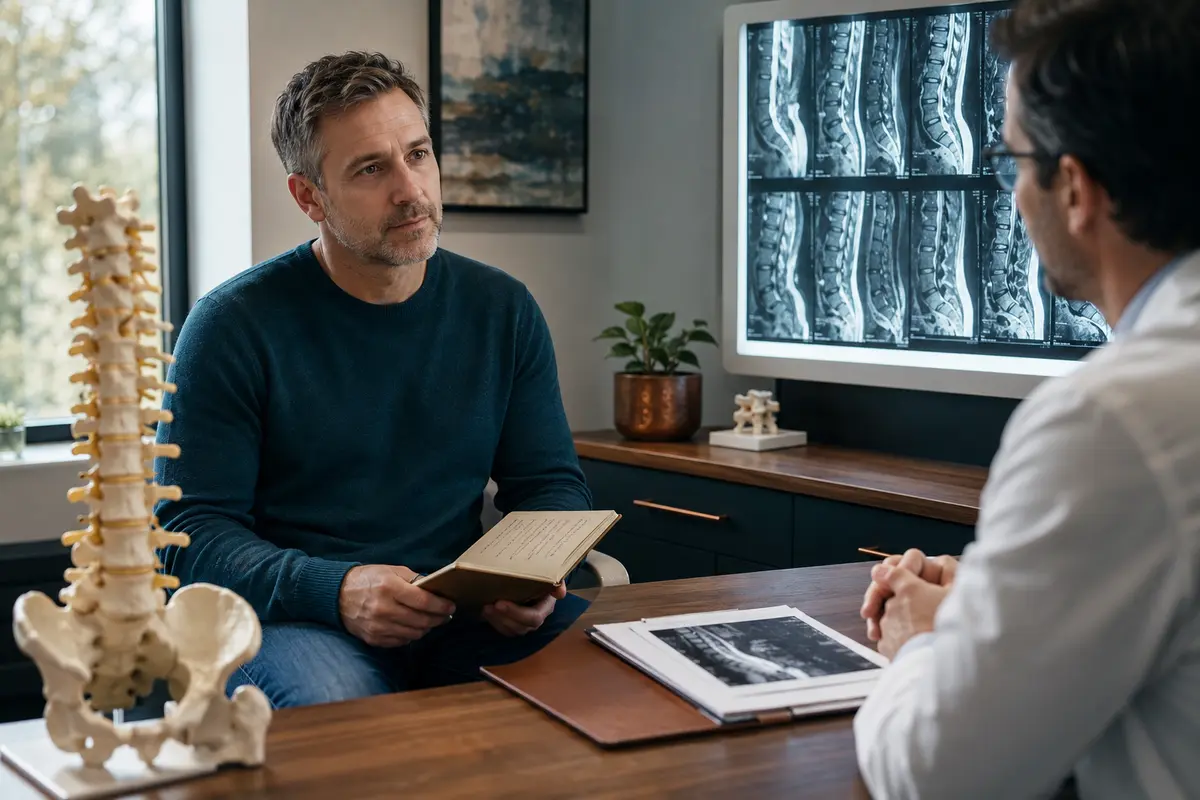
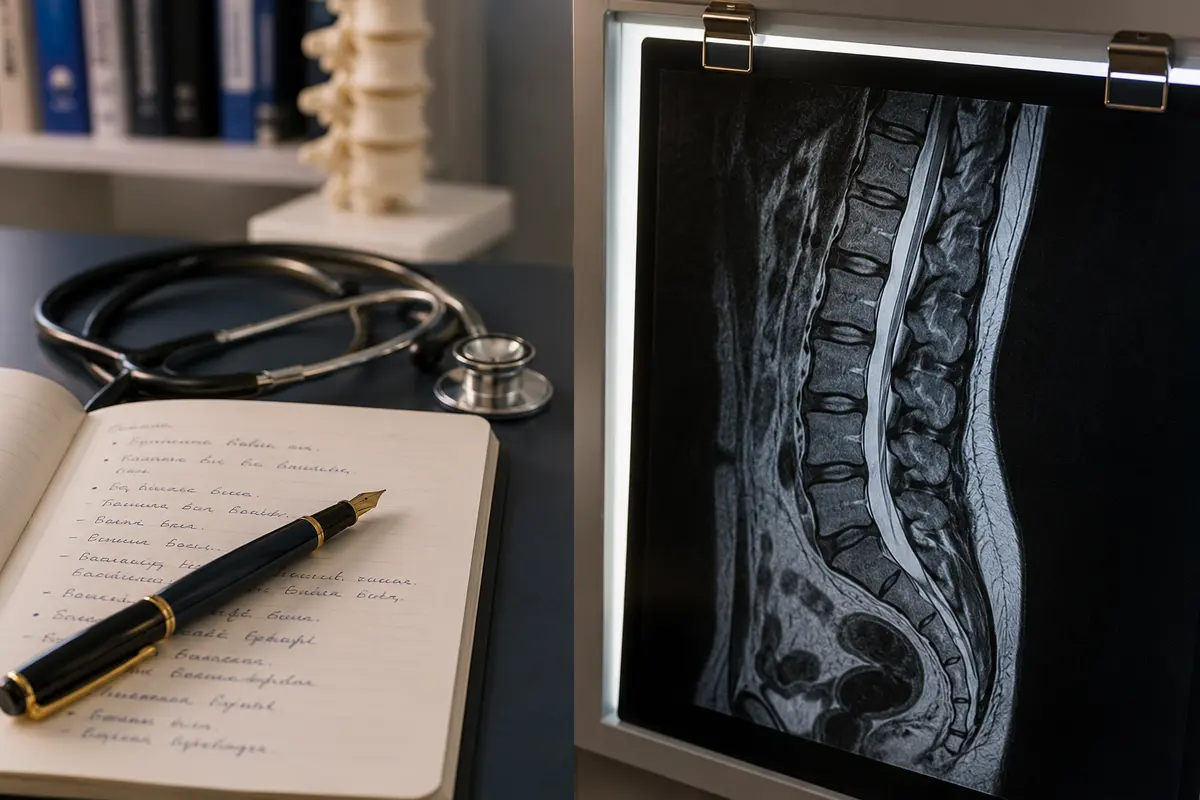
Ask your surgeon to name the diagnosis precisely and show you on your MRI or CT where it appears. A vague answer like "wear and tear" or "a bad disc" isn't enough to justify an operation.
A solid surgical plan connects three things: your symptoms, your physical examination findings, and your imaging. If any of those three don't line up, the surgery is less likely to help. For example, an L4-L5 disc herniation visible on MRI only matters if your leg pain follows the L5 nerve distribution and your exam shows weakness or sensory change in that pattern.
Common mistake: Treating the MRI rather than the patient. Many people over 40 have disc bulges on imaging with no symptoms at all, as documented in Brinjikji et al. (2015) on PubMed.
2. Am I a good candidate for spine surgery, and why now?
A good candidate has a clear structural problem, symptoms that match it, and has either exhausted reasonable non-surgical care or has a red flag that justifies acting quickly. Ask your surgeon to explain which of those applies to you.
You may be a strong candidate if you have:
- Persistent radicular leg or arm pain beyond 6–12 weeks despite proper conservative care
- Progressive neurological deficit (weakness, numbness getting worse)
- Spinal instability or significant deformity on imaging
- Cauda equina symptoms (bladder/bowel changes, saddle numbness) — this is urgent
You may not be a good candidate if your main complaint is axial back pain alone with diffuse imaging findings, or if you haven't tried structured physiotherapy.
"Surgery is a tool, not a verdict. The question isn't only 'can we operate?' but 'should we, and should we now?'"
3. What are the different types of spine surgeries available for my problem?
Most spinal conditions have more than one surgical option, and the choice between them shapes your recovery and risk profile. Ask which procedures are reasonable for your case and why your surgeon prefers one over the others.
If a fusion is being recommended, ask specifically whether a decompression alone could work. Fusions carry higher complication rates and adjacent-segment problems over time.
4. What non-surgical alternatives should I try first?
For most non-emergency spine problems, structured conservative care is the recommended first step. NICE guidance on low back pain and sciatica (NG59) supports exercise-based rehabilitation, manual therapy as an adjunct, and selective use of imaging and injections before surgery is considered.
Reasonable alternatives include:
- Supervised physiotherapy focused on movement and strengthening, not just passive treatment
- Activity modification rather than bed rest
- Short-term analgesia per your physician's advice
- Image-guided epidural or nerve root injections in selected radicular cases
- Cognitive and pain education approaches for chronic back pain
Decision rule: If you haven't had at least 6–12 weeks of properly delivered conservative care for a non-urgent problem, you usually have time to try it before consenting to surgery.
5. How successful is this surgery for my specific condition?
Success rates depend heavily on diagnosis, not on the word "spine surgery" in general. Ask your surgeon for the realistic figure for someone with your exact problem — not the best-case marketing number.
Broad ranges from the published literature (Cochrane and PubMed cohort studies):
- Microdiscectomy for sciatica: roughly 80–90% report meaningful leg pain relief in the first year
- Decompression for lumbar stenosis: around 70–80% report functional improvement
- Lumbar fusion for degenerative back pain alone: more variable, often quoted around 50–70%
- Cervical disc replacement or ACDF for radiculopathy: typically 80–90% symptom relief
Note these are estimates synthesised from the literature and vary by study. Ask your surgeon for their own audited results and how they define "success" — pain reduction, function, return to work, or patient-reported satisfaction.
6. What are the risks and potential complications?
Every spine operation carries risks. A trustworthy surgeon names them clearly, in numbers where possible, before you sign.
General risks across most spine procedures include:
- Infection (typically 1–4% depending on procedure)
- Bleeding and blood clots
- Dural tear and cerebrospinal fluid leak
- Nerve injury (rare but possible, including new weakness or numbness)
- Anaesthetic complications
- Failure to relieve symptoms ("failed back surgery syndrome")
- For fusions: non-union (pseudarthrosis), hardware problems, adjacent-segment degeneration
- Rare but serious: paralysis, major vascular injury
Ask specifically: "What is your personal complication rate for this procedure, and how do you handle complications when they occur?"
7. How do I know if my surgeon is experienced in this specific procedure?
Volume and focus matter. Studies on surgeon volume in spine surgery (PubMed) consistently show that surgeons who perform a procedure frequently have lower complication rates than those who do it occasionally.
Fair questions to ask:
- How many of this exact procedure do you perform each year?
- What percentage of your practice is this type of case?
- Are you fellowship-trained or certified in spine surgery specifically (for example DWG certification in Germany, FRCS spine fellowship in the UK, similar credentials elsewhere)?
- Can I see your audited outcomes or patient-reported data?
- Do you work in a centre with a multidisciplinary spine team?
A high-volume surgeon performing a procedure they do every week is, on average, a safer choice than a generalist doing it a few times a year.
8. How long is recovery, and what restrictions will I have?
Recovery varies by procedure, but you should leave the consultation with a clear timeline for walking, sitting, driving, working, lifting, and returning to sport. Generic answers like "a few weeks" aren't enough.
Typical ranges (individual results vary):
- Microdiscectomy: walking same day, light desk work in 1–2 weeks, full activity in 6–12 weeks
- Laminectomy: similar to microdiscectomy, slightly longer for heavier work
- Single-level lumbar fusion: 3–6 months for solid bony healing, lifting restrictions for at least 6–12 weeks
- Cervical ACDF or disc replacement: soft tissue healing in weeks, return to most activity in 6–12 weeks
Common restrictions after lumbar surgery include limits on bending, twisting, and lifting (often nothing heavier than 5 kg) for several weeks. For fusions, smoking cessation is critical because nicotine impairs bone healing.

9. What common mistakes do patients make after spine surgery, and how can I prepare?
The most common post-operative mistakes I see are doing too much too soon, skipping physiotherapy, ignoring red-flag symptoms, and continuing to smoke after a fusion. Preparation before surgery genuinely changes outcomes.
To prepare your body:
- Optimise general health: stop smoking (ideally 6+ weeks before), control blood sugar if diabetic, reach a healthy weight where realistic.
- Build baseline strength with prehab physiotherapy if your symptoms allow.
- Review medications with your doctor — some anti-inflammatories, blood thinners, and supplements need to be paused.
- Arrange home support: someone to help for the first 1–2 weeks, a firm chair, items at waist height to avoid bending.
- Plan mental health support. Pre-operative anxiety and depression are linked to worse outcomes in spine surgery cohorts.
Edge case: If you have ongoing untreated depression, severe deconditioning, or unrealistic expectations, addressing those before surgery often improves results more than changing the surgical plan itself.
10. What happens if I wait, or get a second opinion first?
For most non-emergency spine problems, waiting a few weeks to get an independent second opinion does not worsen your outcome. Ask your surgeon directly: "If I take four to six weeks to get a second opinion and try more conservative care, what is the realistic risk?"
A confident, ethical surgeon will welcome this question. If the honest answer is "you can safely wait," that's reassuring. If there's a genuine reason to act quickly (progressive weakness, instability, cauda equina), they should explain it in concrete terms.
What about cost? Spine surgery pricing varies hugely by country and health system, so I won't quote figures here. What I can say internationally: an online second opinion is almost always far less expensive than the surgery itself, and many patients find it the single highest-value step in their decision-making.
What percentage of spine surgeries actually solve the original problem?
Honest answer: it depends on the procedure and diagnosis, but broadly, most well-indicated spine surgeries help most patients, while a meaningful minority do not get the result they hoped for. Microdiscectomy and decompression for clear nerve compression tend to perform best. Fusions for non-specific back pain perform least predictably. This is exactly why patient selection — and a second opinion — matters so much.
FAQ
How long should I think about it before agreeing to spine surgery?
For non-emergency cases, taking two to six weeks to consider, gather questions, and seek a second opinion is reasonable and rarely harmful. Urgent red flags are the exception.
Is an online second opinion as reliable as an in-person one?
For reviewing imaging, reports, and surgical plans, a structured online second opinion by a qualified spine surgeon is well-suited. Physical examination still requires in-person assessment, which your treating surgeon provides.
Will my surgeon be offended if I get a second opinion?
A professional surgeon should not be. Second opinions are standard practice in modern spine care and are encouraged by major guidelines and patient-safety bodies.
What are the warning signs that I need surgery sooner rather than later?
Progressive weakness, foot drop, loss of bladder or bowel control, saddle numbness, or rapidly worsening neurological function. These warrant urgent assessment, not a waiting period.
Are minimally invasive or endoscopic techniques always better?
Not always. They can mean less tissue damage and faster recovery for the right indications, but the best technique is the one that reliably addresses your specific problem in experienced hands.
Can spine problems get better without any surgery?
Yes, often. Many disc herniations shrink on their own over months, and most episodes of back pain improve with time and active rehabilitation.
Conclusion: Use the checklist, then get an independent opinion
Informed consent isn't a signature — it's a conversation. Walk into your next appointment with these ten questions written down, take notes on the answers, and notice how your surgeon responds to being questioned. Curiosity and clarity are good signs.
Your next steps:
- Print or save this checklist and bring it to your next consultation.
- Request copies of your imaging (MRI/CT) and reports — you own this data.
- Try, or confirm you've tried, an appropriate course of conservative care unless red flags say otherwise.
- Get an independent online second opinion from a qualified spine surgeon before agreeing to anything irreversible.
This article is educational and not a substitute for individualised medical advice. If you're weighing spine surgery anywhere in the world, an independent review of your case — including your imaging, history, and proposed plan — is one of the most useful decisions you can make. That's exactly what I do for patients internationally, and even if you don't choose my service, please choose someone qualified to give you that second look.