
Last updated: June 20, 2026
Quick Answer
An online MRI review for the spine is a remote, specialist-led assessment of your MRI scans and clinical history, usually delivered as a written report or video consultation. It's most useful when surgery has been recommended and you want an independent opinion on whether that surgery is truly necessary, what alternatives exist, and what the realistic risks are. You'll need your full MRI images (not just the report), a recent clinical summary, and a description of your symptoms. As a board-certified, DWG-certified spine surgeon based in Stolberg, Germany, I review cases from patients across the world, and a meaningful share end up not needing the operation they were initially offered.
Key Takeaways
- An online MRI review spine consultation is an independent specialist assessment of your imaging and symptoms, performed remotely.
- You need the actual DICOM image files, not only the written radiology report — the report alone is rarely enough.
- Surgery rates for common conditions like lumbar disc herniation vary widely between regions and surgeons, which is one reason second opinions matter.
- A second opinion does not replace in-person evaluation when physical examination or new tests are clinically needed.
- Most spine conditions improve with conservative care; surgery is usually elective and time-sensitive emergencies are rare (e.g. cauda equina syndrome).
- Expect a clear written summary covering diagnosis, surgical necessity, alternatives, and questions to ask your local surgeon.
- An online second opinion is educational — it informs your decision but does not establish a treating doctor-patient relationship in most jurisdictions.
What Is an Online MRI Review for the Spine?
An online MRI review spine consultation is a structured, remote evaluation in which a spine specialist examines your MRI images, reads your clinical history, and gives you an independent opinion on diagnosis and treatment options. It is not a radiology re-read. It's a surgical and clinical interpretation focused on one practical question: do you actually need the operation that has been proposed, and if so, which one and when?
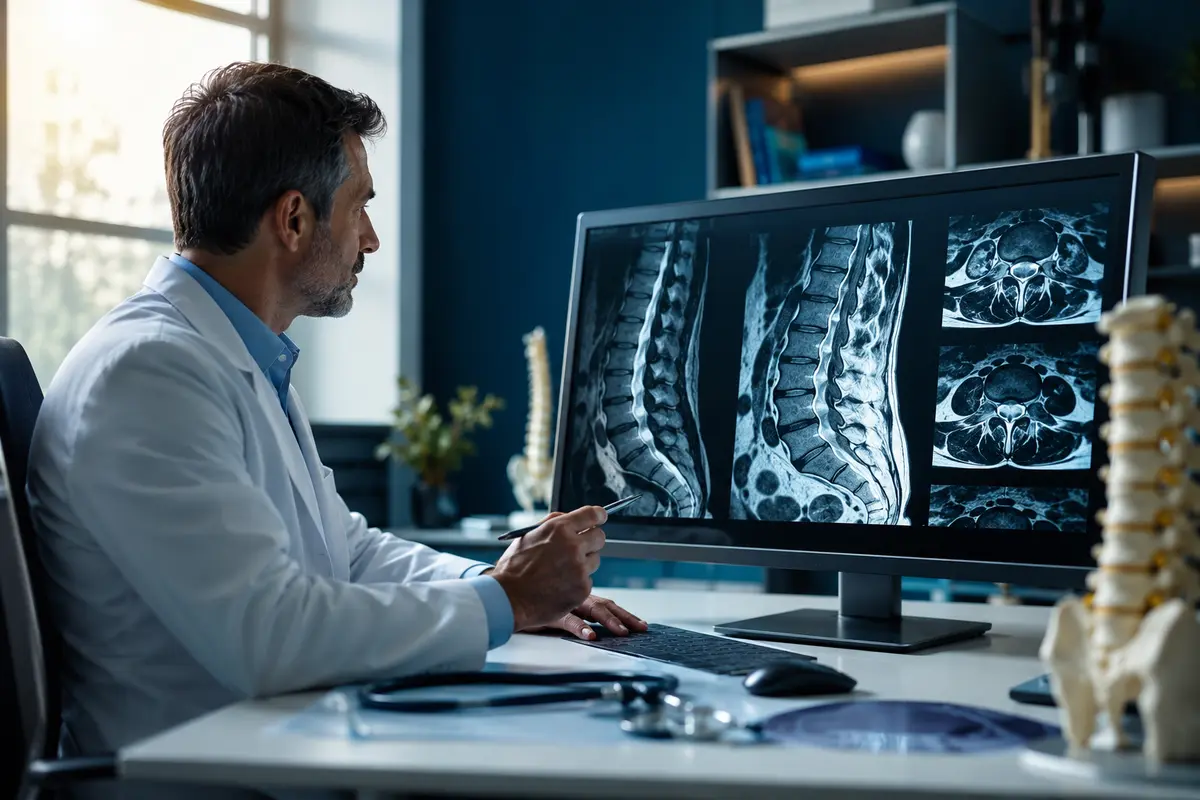
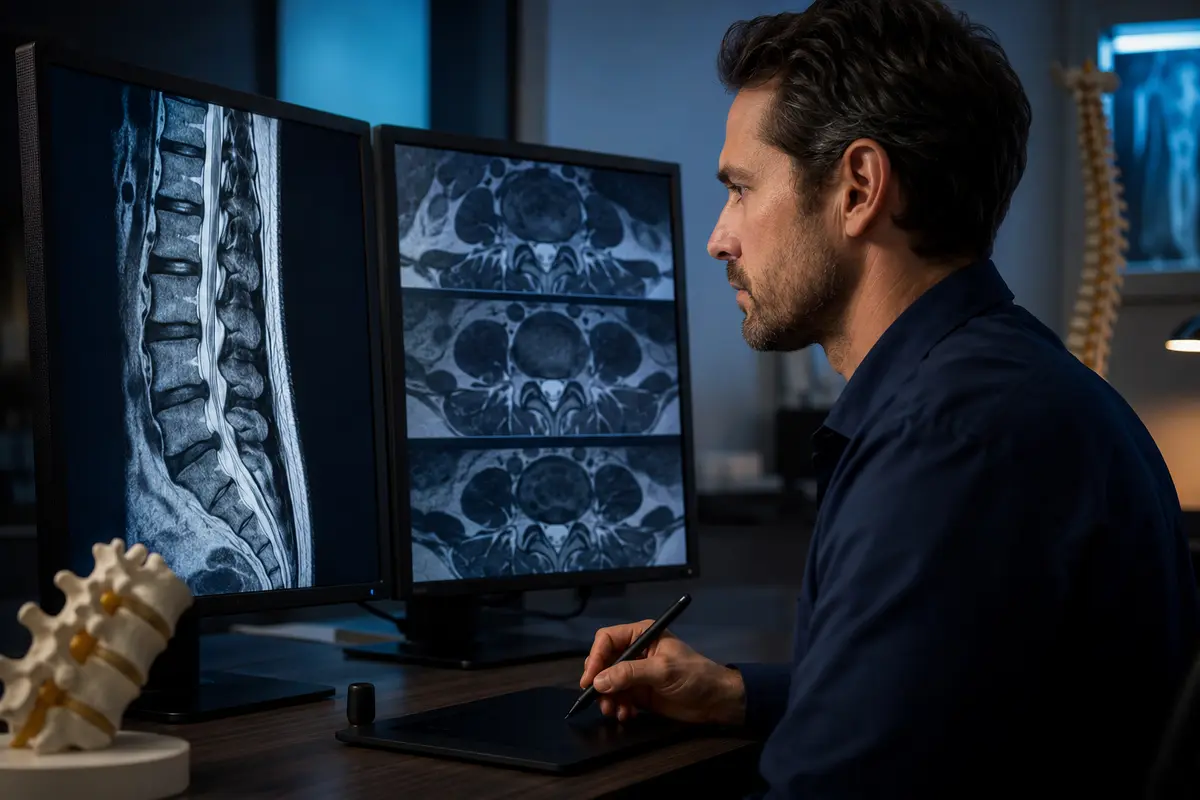
In my practice I review the imaging slice by slice on diagnostic software, cross-check it against your symptoms and examination notes, and then write a plain-language report. Patients typically receive this within a few working days, often followed by a video call to discuss it.
Choose an online review if: surgery has been recommended, you have time to plan (no red-flag emergency), and you want a specialist outside your local system to look at the same images.
Don't rely on it alone if: you have signs of cauda equina syndrome (saddle numbness, new bladder or bowel dysfunction, rapidly progressive leg weakness), severe trauma, suspected infection, or a known tumour. These need urgent in-person care.
Who Should Consider an Online Spine Second Opinion?
A remote second opinion is most valuable for patients facing elective spine surgery — lumbar discectomy, decompression, fusion, cervical discectomy, disc replacement, or scoliosis correction — where the decision is genuinely a choice, not an emergency.
You're a good candidate if any of these apply:
- A surgeon has recommended fusion, instrumentation, or multi-level surgery.
- Your symptoms don't match the severity of the imaging findings (or vice versa).
- You've been told you need surgery within days or weeks, but you don't have neurological emergency signs.
- You've had previous spine surgery and now another procedure is proposed.
- You want to understand non-surgical alternatives before committing.
- You're being treated abroad and want a specialist in your home language or region.
Cochrane reviews on lumbar disc herniation and spinal stenosis have repeatedly shown that, for most patients without severe or progressive neurological deficit, outcomes at one to two years are broadly similar between surgical and well-structured non-surgical care. That doesn't mean surgery is wrong — it means the decision deserves careful thought.

How Do I Gather My MRI for an Online Review?
You need three things: the actual MRI image files, the radiologist's written report, and a clinical summary from your treating doctor. The image files are the critical piece — without them, a meaningful review isn't possible.
Step 1: Request your imaging in DICOM format
DICOM is the international medical imaging standard. Every hospital and imaging centre can provide it. Ask specifically for:
- The full MRI study (all sequences: T1, T2, STIR, with and without contrast if performed)
- All anatomical planes (sagittal, axial, coronal)
- The DICOM files, not just JPEG screenshots or the printed report
You'll usually receive them on a CD/DVD, a USB stick, or via a secure download link. If you only have a CD and no disc drive, an inexpensive external USB drive solves this.
Step 2: Collect supporting documents
- The radiology report (PDF or printed)
- Any previous MRI, CT, or X-ray for comparison — progression matters more than a single snapshot
- A letter or notes from your treating surgeon, including the proposed operation
- A list of medications, prior treatments (physiotherapy, injections, prior surgery), and current symptoms
Step 3: Upload securely
Reputable providers use encrypted, GDPR-compliant upload portals. Avoid emailing imaging as attachments. If a service asks you to send DICOM files over standard email without encryption, that's a red flag.
Common mistake
Sending only the radiology report. The report reflects one radiologist's reading at one moment. A second specialist needs to see the actual images to form an independent opinion. A finding of "broad-based disc protrusion contacting the L5 nerve root" can look very different on the actual scan than it sounds on paper.
What Happens During the Remote Review Process?
The process is straightforward and typically takes one to two weeks from upload to written report. Here is how I run it, and most reputable services follow a similar structure.
A good written report should clearly state:
- What the imaging shows — in language you can understand.
- Whether the proposed surgery is reasonable given the findings and your symptoms.
- What alternatives exist — physiotherapy, targeted injections, watchful waiting, a different surgical approach.
- What the realistic risks and benefits are, without overpromising.
- What questions to ask your local treating surgeon.
I deliberately avoid making the report a sales document for surgery I would perform. The point is your decision, not my schedule.
What Outcomes Can I Realistically Expect?
The honest answer: a second opinion changes the recommended treatment plan in a meaningful minority of cases, and confirms it in many others. Both outcomes are valuable.
Published studies on spine second opinions (including work indexed on PubMed from academic centres in the US and Europe) have reported that somewhere between roughly 15% and 40% of patients receive a different recommendation after an independent review — often a recommendation for less invasive or non-surgical care first. The exact figure varies by setting, specialty mix, and patient selection, so I won't quote a single number as gospel.
What I can say from clinical experience:
- Confirmation is reassuring. If two independent specialists agree, you can proceed with more confidence.
- Disagreement is informative. It usually means the case is genuinely borderline, and you deserve to understand why before committing.
- De-escalation is common. Often the alternative is not "no treatment" but a structured trial of conservative care first, with surgery held in reserve.
A second opinion is not about finding someone to tell you what you want to hear. It's about making sure the decision is the right one — for your spine, your life, and your timeline.
What it won't do
- It won't guarantee a specific outcome. No honest surgeon can.
- It won't replace a physical examination if one is clinically indicated.
- It won't override emergency care. Red-flag symptoms need immediate in-person assessment.
How Do I Choose a Trustworthy Online MRI Review Spine Service?
Look for a board-certified spine specialist (neurosurgeon or orthopaedic spine surgeon) with verifiable credentials, transparent pricing, GDPR-compliant data handling, and a clear written report — not just a phone call.
Practical checklist:
- Credentials: Board certification in neurosurgery or orthopaedic surgery, with spine fellowship or society membership (e.g. DWG in Germany, EuroSpine, WFNS-recognised training).
- Independence: The reviewer should not be financially incentivised to recommend surgery they would personally perform.
- Data protection: GDPR compliance, encrypted upload, clear data retention policy.
- Deliverable: A written report you can keep and share with your local team.
- Scope clarity: The service should clearly state that it is a second opinion, not a treating relationship, and recommend in-person care where needed.
- No outcome guarantees: Be cautious of any service promising specific results.
Red flags
- Pressure to book surgery abroad immediately after the review.
- Reluctance to provide a written report.
- No verifiable surgeon name or credentials.
- Unencrypted file transfer.
- Vague or "all-included" pricing without clear scope.
What Does an Online Spine Second Opinion Cost and How Long Does It Take?
Costs vary widely by country and specialist, generally ranging from a few hundred to around a thousand euros or equivalent for a written report plus video consultation. Timelines are typically one to two weeks. I won't quote specific figures here because they change and vary by provider; ask for written pricing before you upload anything.
What should be included in a transparent fee:
- Full image review of all sequences
- Written report
- One video consultation to discuss findings
- Follow-up clarification questions within a defined window
What is usually not included:
- Ongoing treatment
- Prescriptions
- Coordination with your local team beyond the report (sometimes available as an add-on)
Conclusion: Your Next Steps
If surgery has been recommended for your spine and you have any doubt, gather your imaging in DICOM format, write down your symptoms and treatment history, and arrange an independent online MRI review spine consultation before you commit. Most spine surgery is elective. You almost always have time to think carefully.
Concretely, this week you can:
- Request your full MRI study on DICOM from the imaging centre.
- Collect your radiology report and surgeon's letter.
- Write a one-page summary of your symptoms, what makes them better or worse, and treatments you've already tried.
- Choose a board-certified, independent reviewer and submit your files through a secure portal.
- Read the written report carefully and bring its questions to your local surgeon.
If you'd like me to review your case, you can request a confidential online second opinion through my practice. I'll tell you honestly what I see, what I'd consider, and what questions I think you should ask — whether or not surgery ends up being the right choice for you.
This article is educational and does not constitute personal medical advice. For any new, worsening, or red-flag symptoms, please seek in-person care promptly.
FAQ
Is an online MRI review spine consultation as good as an in-person visit?
For interpreting imaging and discussing surgical necessity, a remote review by a qualified specialist is highly informative. It does not replace a physical examination when one is clinically needed, but for the question "do I need this operation?" it is often sufficient as a second opinion.
Do I need to send the radiology report or the actual MRI images?
Both, but the actual DICOM image files are essential. The report alone is not enough for a meaningful independent review.
Can a remote second opinion delay urgent care?
It shouldn't, if you choose the right path. Emergencies like cauda equina syndrome, severe progressive weakness, suspected infection, or trauma need immediate in-person care, not a remote review. For elective surgery, a one- to two-week review window is rarely harmful and is often clinically appropriate.
Will my data be safe?
A reputable service uses encrypted, GDPR-compliant upload and storage, with a clear data retention and deletion policy. Avoid services that ask you to email DICOM files unencrypted.
What if the second opinion disagrees with my surgeon?
That's useful information, not a verdict. Take the written report to your local surgeon and ask them to address the specific points. Borderline cases benefit from open discussion between specialists.
Does an online review establish a doctor-patient treatment relationship?
In most jurisdictions, no. It's an educational second opinion. Treatment decisions and prescriptions remain with your local treating team unless you formally transfer care.
Can I get an online MRI review spine consultation if I live outside Europe?
Yes. I review cases from patients internationally. The process is the same: secure upload of DICOM files, written report, optional video consultation, ideally in a language you're comfortable with.