
Last updated: June 5, 2026
Most patients are walking the same evening as their lumbar microdiscectomy, yet I still meet people who were told they'd be "off their feet for months". That gap between expectation and reality is where a lot of unnecessary anxiety lives — and where good recovery decisions go sideways.
Quick Answer
Microdiscectomy recovery typically follows a predictable arc: walking on day one, light desk work in 2–4 weeks, return to most activities by 6–8 weeks, and near-complete recovery by 3–6 months. Leg pain often improves dramatically within days, while back soreness and core strength take longer. Outcomes are generally favourable, but recovery depends on age, fitness, nerve health before surgery, and how carefully you follow rehabilitation guidance.
Key Takeaways
- Lumbar microdiscectomy is one of the most successful spine operations, with leg-pain relief reported in roughly 80–90% of well-selected patients in the published literature.
- You can walk the day of surgery. Bed rest is not advised.
- Most office workers return to work in 2–4 weeks; physically demanding jobs typically need 6–12 weeks.
- Avoid heavy lifting, repeated bending, and twisting for the first 4–6 weeks.
- Structured physiotherapy from around week 2–4 improves functional outcomes.
- Re-herniation occurs in roughly 5–15% of cases; warning signs include sudden return of severe leg pain, weakness, or bladder changes.
- An independent second opinion before surgery is reasonable — many disc herniations improve without an operation.
How long does microdiscectomy recovery usually take?
Most people feel substantially better within 2–6 weeks and reach full recovery between 3 and 6 months. The leg pain (sciatica) that drove you to surgery often eases within days, because the nerve root is no longer compressed. Back soreness around the incision and deep muscle fatigue take longer to settle.
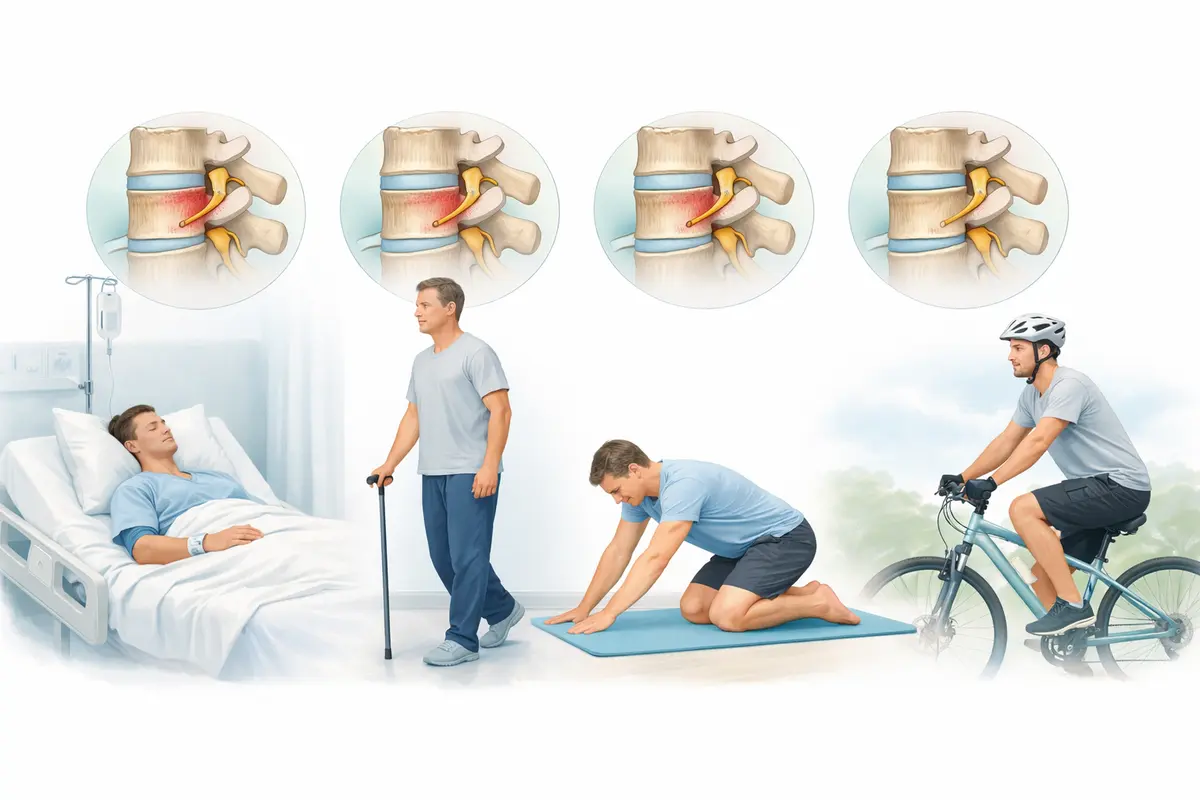
Here's a realistic timeline I share with my own patients:
This is a guide, not a guarantee. Your trajectory depends on the size of the herniation, how long the nerve was compressed before surgery, and your baseline fitness.
What activities can I do during microdiscectomy recovery?
Walking is the single best activity in the first two weeks. It promotes circulation, prevents stiffness, and protects against blood clots without loading the disc.
In the first 6 weeks, safe activities usually include:
- Walking, gradually increasing distance
- Gentle stationary cycling (upright posture, low resistance) from around week 3–4
- Swimming or aqua-walking once the wound is fully healed (usually 3–4 weeks)
- Light household tasks at counter height
- Driving short distances once you can perform an emergency stop without hesitation — usually 1–2 weeks
What's off-limits early on: lifting more than around 5 kg, repeated forward bending, twisting under load, and high-impact sport.
Tips for managing pain after microdiscectomy surgery
Most post-operative pain is well controlled with simple measures and short-term medication. Pain after a microdiscectomy is usually mechanical (muscle, incision) rather than nerve pain — which is a good sign.
Practical strategies:
- Use a stepped approach to medication. Paracetamol around the clock, with a short course of NSAIDs if your surgeon agrees (some prefer to avoid NSAIDs in the first 2 weeks because of theoretical effects on healing — discuss with your team).
- Ice for 15–20 minutes several times a day in the first week, then switch to gentle heat if it feels better.
- Change position often. Don't sit longer than 30–45 minutes at a stretch in the first 2 weeks.
- Sleep matters. Poor sleep amplifies pain. Prioritise it.
- Move early, but rest when you need to. The body heals when you alternate gentle activity with recovery.
If your leg pain comes back severely, that's not normal post-op soreness — flag it to your surgeon.
When can I return to work after microdiscectomy?
Desk-based workers typically return in 2–4 weeks; physically demanding jobs need 6–12 weeks. The key factor is not "feeling fine" but being able to do your actual job safely.
A reasonable rule of thumb:
- Sedentary work (computer, calls): 2–3 weeks, with the option to stand and walk regularly
- Light manual work (teaching, retail, light healthcare): 4–6 weeks
- Heavy manual work (construction, nursing with lifting, agriculture): 8–12 weeks, often with a graded return
Returning too soon to heavy lifting is one of the most common reasons I see for re-herniation in the published literature and in clinical practice.
What should I avoid during microdiscectomy recovery?
In the first 6 weeks, avoid heavy lifting, repeated bending, twisting, prolonged sitting, and high-impact activity. These loads place the highest stress on the healing disc.
Specifically:
- No lifting over ~5 kg in weeks 1–4, and no more than ~10–15 kg until around week 6
- No twisting while lifting (e.g. moving a shopping bag from boot to back seat)
- No running, jumping, or contact sport for at least 6–8 weeks
- No long car journeys without breaks every 30–45 minutes
- No smoking — nicotine impairs disc healing (well established in the spine literature)
Best positions to sleep in after microdiscectomy
The best sleeping positions are on your back with a pillow under your knees, or on your side with a pillow between your knees. Both keep the lumbar spine in a neutral position.
A few practical points:
- Avoid sleeping flat on your stomach — it extends the lower back.
- Use the "log roll" to get out of bed: roll onto your side, push up with your arms while swinging your legs down together.
- A medium-firm mattress is generally most comfortable. You don't need to buy a new one.
Physical therapy and exercises to help heal faster
Structured physiotherapy starting around week 2–4 improves outcomes and reduces the risk of chronic back pain. Cochrane reviews of post-microdiscectomy rehabilitation generally support exercise-based programmes over no formal rehab.
A typical progression I recommend:
Weeks 1–2: Walking, gentle ankle pumps, diaphragmatic breathing, pelvic tilts.
Weeks 3–6 (with a physiotherapist):
- Pelvic tilts and bridges
- Bird-dog (opposite arm and leg lift on hands and knees)
- Dead bug variations
- Cat-camel mobility
- Gentle hip flexor and hamstring stretches
Weeks 6–12:
- Progressive core strengthening (planks, side planks)
- Hip and gluteal strengthening (bridges, clamshells, step-ups)
- Light resistance training with neutral spine
- Stationary bike and swimming for cardiovascular fitness
After 3 months:
- Gradual return to deadlifts, squats, running with good technique
- Sport-specific work
The aim is not just to heal — it's to build a spine that's more resilient than before.
Common complications and signs of potential problems
Most microdiscectomies are uncomplicated, but you should know the warning signs. Complications occur in a minority of cases and most are manageable when caught early.
Contact your surgeon promptly if you notice:
- Sudden, severe return of leg pain (possible re-herniation, reported in roughly 5–15% of cases in the literature)
- New or worsening weakness in the foot or leg
- Fever above 38°C, increasing redness, swelling, or discharge from the wound (possible infection, around 1–2%)
- Persistent severe headache, especially when standing (possible dural leak)
- A hard, swollen calf or sudden shortness of breath (possible blood clot)
Seek emergency care immediately if you have:
- Loss of bladder or bowel control
- Numbness in the saddle area (inner thighs, genitals, buttocks)
- Rapidly progressing leg weakness
These can indicate cauda equina syndrome — rare, but a surgical emergency.
How to tell if your microdiscectomy recovery is going normally
Normal recovery is characterised by steady, if uneven, improvement in leg pain, gradually reducing back soreness, and increasing tolerance for activity over weeks. Good days and bad days are expected — the overall trend is what matters.
Reassuring signs:
- Leg pain noticeably better within the first 1–2 weeks
- Incision dry, closed, and not increasingly red or painful
- Able to walk further each week
- Sleep improving
- Medication need decreasing
Less reassuring signs (worth a call to your surgeon, not necessarily an emergency):
- Plateau in symptoms after 4–6 weeks
- New pins-and-needles in a different distribution
- Back pain getting worse rather than better after week 3

Microdiscectomy recovery compared to spinal fusion
Microdiscectomy recovery is substantially shorter and less restrictive than fusion recovery. A microdiscectomy removes only the herniated fragment; a fusion permanently joins two or more vertebrae, which is a much bigger biological undertaking.
This contrast is one reason I always encourage patients offered fusion for a simple disc herniation to seek a second opinion. The two operations are not interchangeable.
Average recovery time for different age groups
Younger patients generally recover faster, but age alone is rarely the limiting factor — overall health, fitness, and nerve recovery matter more. Here's what I see in practice:
- 20s–30s: Often back to desk work in 1–2 weeks, full sport by 8–12 weeks
- 40s–50s: Desk work in 2–4 weeks, full activity by 3–4 months
- 60s–70s: Desk-equivalent activity in 3–6 weeks, full recovery 4–6 months
- Over 75: Recovery is possible and often very worthwhile, but takes longer; rehab is essential
People with diabetes, smokers, and those with significant pre-operative weakness or numbness tend to recover more slowly regardless of age.
Should you get a second opinion before microdiscectomy?
A second opinion is reasonable whenever surgery is recommended for a non-emergency disc herniation. Many lumbar disc herniations improve without surgery over 6–12 weeks, and imaging alone doesn't decide who needs an operation — the clinical picture does.
I provide online spine second opinions to patients internationally, and the most common scenarios where a second look adds value are:
- Surgery offered within weeks of symptom onset, without a trial of conservative care
- Fusion recommended for a single-level disc herniation
- Imaging findings that don't match the symptoms
- Uncertainty about whether the right level is being operated on
A second opinion isn't about distrust — it's about clarity before an irreversible decision.
FAQ
Is microdiscectomy recovery painful?
Most patients describe moderate soreness for 1–2 weeks, well controlled with simple analgesia. The pre-operative leg pain is often gone within days.
Can I bend over to tie my shoes after microdiscectomy?
Avoid deep forward bending in the first 4–6 weeks. Use slip-on shoes, a long shoehorn, or bring your foot up to a chair.
When can I have sex after microdiscectomy?
Most patients can resume gentle sexual activity at 2–4 weeks, choosing positions that avoid loading or twisting the lower back. Listen to your body.
Will my back ever feel "normal" again?
Many patients report their back feels better than before surgery once rehab is complete. Some residual stiffness or weather sensitivity is common but usually doesn't limit daily life.
Can a herniated disc come back after microdiscectomy?
Yes — re-herniation occurs in roughly 5–15% of patients in published series. Good rehab, avoiding smoking, and lifting technique significantly reduce that risk.
Do I really need surgery, or could the disc heal on its own?
Many disc herniations improve without surgery within 6–12 weeks. Surgery is most clearly indicated for cauda equina syndrome, significant or progressive weakness, or persistent disabling pain after a fair trial of conservative care.
Conclusion
Microdiscectomy recovery is usually faster and more straightforward than people expect, but it does ask something of you: walk early, lift carefully, do your physiotherapy, and pay attention to your body's signals. Most patients who follow a sensible plan are back to normal life within 6–12 weeks and to full activity within 3–6 months.
If you're weighing up surgery, three practical next steps:
- Make sure conservative care has had a fair chance, unless your symptoms are severe or progressing.
- Ask your surgeon clear questions: which level, why now, what's the expected recovery, and what are the alternatives?
- Consider an independent online second opinion before committing to an operation — particularly if fusion has been suggested for a disc herniation.
This article is educational and not a substitute for personal medical advice. If you have specific concerns about your spine or your recovery, please arrange an in-person evaluation with a qualified spine specialist.