Last updated: June 4, 2026
A patient flew to see me last spring with two surgical quotes in her bag: one for a cervical fusion, one for an artificial disc. The recommendations were opposite, the prices were different, and nobody had explained why. That conversation is the reason I keep writing about this topic.
Quick Answer
Artificial disc replacement vs fusion is a real choice for selected patients with disc-related neck or low back problems, not a universal upgrade. Disc replacement preserves motion at the operated level and may lower the risk of adjacent-segment disease, while fusion remains the standard for instability, deformity, or multi-level degeneration. The right answer depends on your imaging, diagnosis, age, and bone quality — not on marketing.
Key Takeaways
- Artificial disc replacement (ADR) preserves motion; spinal fusion eliminates it at the treated level.
- Disc replacement candidates are a narrower group: typically younger patients with isolated disc disease and no instability or significant facet arthritis.
- Both procedures show high patient satisfaction in well-selected cases in published trials.
- Adjacent-segment disease is a real concern with fusion; ADR may reduce — but does not eliminate — that risk.
- Recovery is often faster after cervical disc replacement than after fusion, but lumbar recovery is more comparable.
- Cost varies widely by country and healthcare system; implant choice rarely drives the decision in public systems.
- An independent second opinion is one of the most useful things you can do before committing to either surgery.
What exactly is artificial disc replacement surgery?
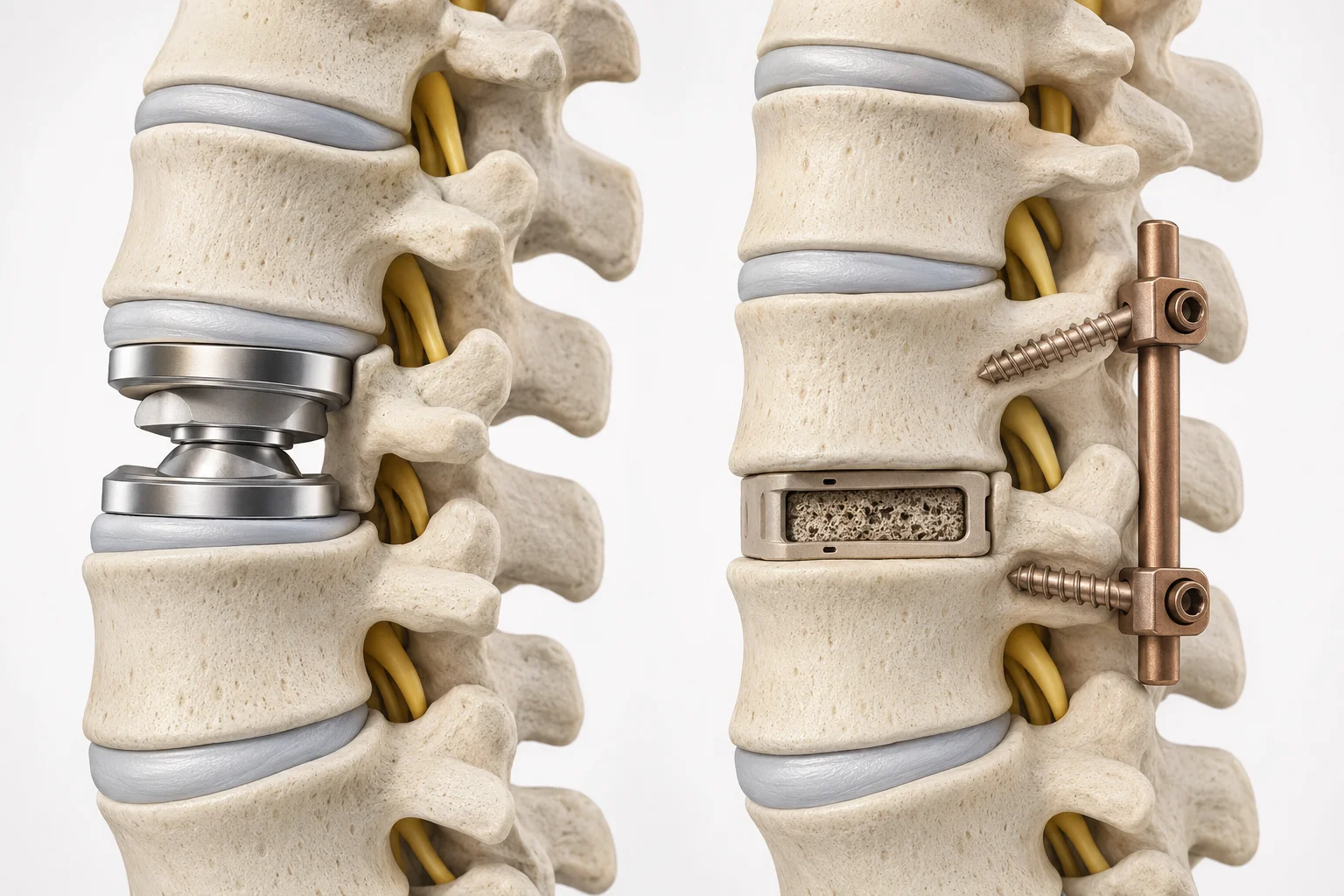
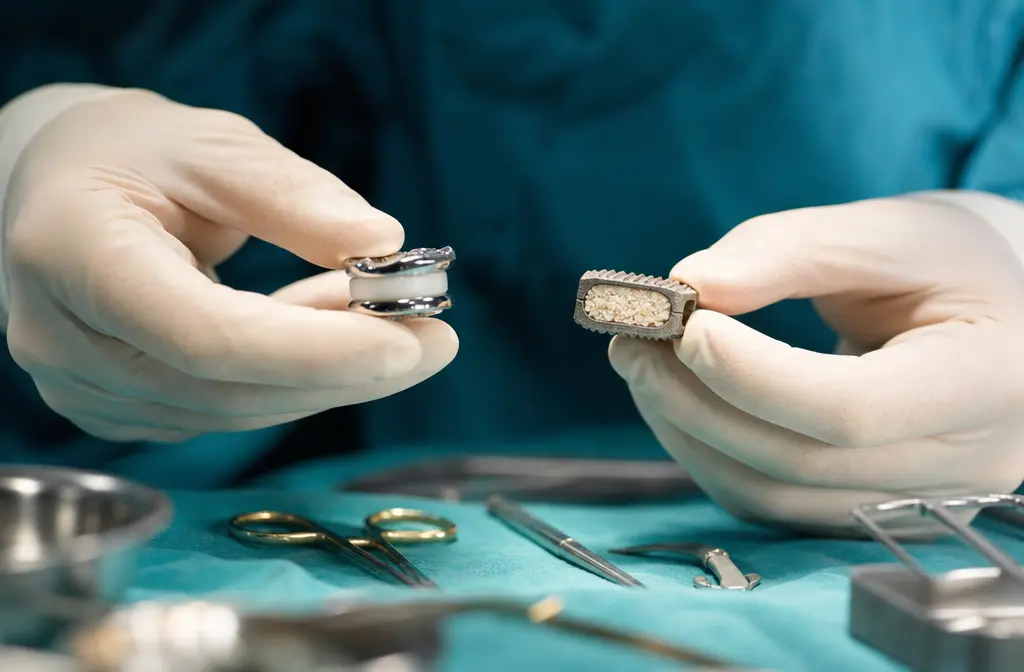
Artificial disc replacement is a motion-preserving spine surgery where a damaged intervertebral disc is removed and replaced with a mechanical prosthesis that allows the vertebrae above and below to keep moving. It's most commonly performed in the cervical spine (neck) and, less often, the lumbar spine (low back).
The implant is usually made of titanium or cobalt-chromium alloy with a polyethylene or ceramic bearing surface. The goal is to restore disc height, decompress nerves, and maintain near-normal segmental motion. Compare that with spinal fusion, where the disc is removed and the two vertebrae are permanently joined with a cage, bone graft, and often screws and rods.
Choose ADR if you have a single (or two-level) symptomatic disc, good bone quality, no instability, and preserved facet joints. Choose fusion if you have instability, spondylolisthesis, deformity, severe facet arthritis, or multi-level degenerative disease.
How does disc replacement compare to traditional fusion surgery?
Here's a direct side-by-side of the two procedures based on standard surgical practice and published comparative trials.
The most cited evidence base comes from the US FDA Investigational Device Exemption (IDE) trials for cervical disc prostheses, plus long-term follow-up studies published in journals such as The Spine Journal and Journal of Neurosurgery: Spine. Many of these trials show ADR is non-inferior to fusion at 2, 5, and 7 years, with some showing lower reoperation rates at adjacent levels.
Am I a good candidate for disc replacement or fusion?
You're likely a better candidate for disc replacement if you have a single-level (or two-level) symptomatic disc herniation or degeneration, good bone density, no significant facet joint arthritis, no spinal instability, and you're roughly between 18 and 60 years old. Fusion is usually the better fit when any of those conditions aren't met.
Specific factors I look at on imaging and history:
- Disc height — too collapsed often means fusion
- Facet joint condition — arthritic facets contraindicate ADR
- Spinal alignment — deformity or instability favours fusion
- Bone quality — osteoporosis is a relative contraindication for ADR
- Previous surgery at the same level — usually pushes toward fusion
- Symptom pattern — pure radiculopathy from a soft disc favours ADR; mechanical back pain alone is a harder call for either
A motion-preserving implant in the wrong spine creates new problems. Patient selection matters more than the device.
What conditions make me not eligible for disc replacement?
Common contraindications for artificial disc replacement include osteoporosis, significant facet joint arthritis, spinal instability or spondylolisthesis, infection, severe deformity (scoliosis or kyphosis at the level), prior fusion at the adjacent level, and certain metal allergies. Pregnancy and active malignancy are also exclusion criteria.
In the lumbar spine, the list of contraindications is longer than in the neck — which is one reason lumbar disc replacement is performed less often worldwide than cervical disc replacement.
Which is better for neck pain: disc replacement or fusion?
For carefully selected patients with cervical radiculopathy or myelopathy from a single- or two-level disc problem, cervical disc replacement performs at least as well as ACDF (anterior cervical discectomy and fusion) in randomised trials, with some advantages in motion preservation and adjacent-segment outcomes. Neither operation is reliably effective for axial neck pain alone.
If your main symptom is arm pain, numbness, or weakness from nerve compression, both procedures can work well. If your main symptom is neck pain without a clear structural cause, surgery of either type is far less predictable, and that's where a second opinion becomes especially valuable.
What are the risks of artificial disc replacement?
Every spine operation carries risk. Specific concerns with ADR include implant migration or subsidence, heterotopic ossification (unwanted bone growth around the implant that limits motion), implant wear, dysphagia (difficulty swallowing after cervical surgery), nerve or vascular injury, infection, and the need for revision surgery. In the lumbar spine, approach-related risks include injury to large blood vessels in front of the spine.
Most studies report serious complication rates in the low single digits for cervical ADR in experienced hands, but published rates vary and your individual risk depends on anatomy, surgeon experience, and comorbidities.
What are common complications with spinal fusion?
Fusion has its own well-documented complication profile: pseudarthrosis (failure of the bones to fuse), hardware loosening or breakage, infection, dural tear, dysphagia (in cervical fusion), blood loss, and — the headline concern over decades — adjacent-segment disease (ASD).
Adjacent-segment disease is degeneration at the levels above or below a fusion, partly from natural ageing and partly from increased mechanical load on neighbouring discs. Reported rates of symptomatic ASD after cervical fusion in long-term studies sit in the range of roughly 2–3% per year, cumulatively becoming clinically significant over 10+ years. This is the single strongest argument in favour of motion preservation when a patient is otherwise a candidate.
How long is recovery after artificial disc replacement?
Most patients return to light desk work 2–4 weeks after cervical ADR and gradually resume normal activity over 6–12 weeks. Lumbar ADR recovery is longer, often 6–12 weeks before returning to work, with full recovery over 3–6 months. Fusion recovery is broadly similar but typically slower in the first weeks because bone healing is part of the process.
A realistic recovery timeline:
- Week 0–2: Wound healing, walking, light daily activities
- Week 2–6: Return to office work, gentle physiotherapy
- Week 6–12: Progressive strengthening, low-impact exercise
- Month 3–6: Most restrictions lifted in uncomplicated cases
- Month 6–12: Full return to sport in well-selected cases
These are averages, not promises. Your timeline depends on your anatomy, surgical findings, and rehabilitation.
Can you still play sports after disc replacement?
Most surgeons clear patients for low- and moderate-impact sport (walking, cycling, swimming, golf, hiking) by 3–6 months after cervical or lumbar ADR. Return to contact sport, heavy weightlifting, or high-impact activity is more individual and should be discussed with your surgeon, ideally with imaging review.
Disc replacement preserves motion, so in principle it's friendlier to active lifestyles than fusion. But "preserved motion" is not "indestructible," and prosthesis-related concerns still apply.
How long do artificial discs typically last?
Modern artificial discs are designed and tested for decades of cyclical loading, and long-term follow-up studies at 7–10 years show good implant survival in the majority of well-selected cervical ADR patients. There isn't yet 30- or 40-year human data for current generations of implants, because the devices haven't existed that long.
Realistically: many implants will outlast the patient's working life, some will require revision, and we won't have lifetime data for current designs for another 20+ years. Be cautious of any source quoting a precise lifespan in years — it's an estimate, not a guarantee.
What are the success rates of artificial disc replacement?
Across the major cervical ADR randomised trials, patient-reported success rates (significant pain and function improvement) at 2 years range broadly from about 80% to over 90% in well-selected single-level cases, with comparable or slightly better numbers than fusion controls. Reoperation rates at the index or adjacent level are generally lower with ADR in long-term follow-up.
These figures apply to carefully selected patients in clinical trials. Real-world results depend heavily on diagnosis accuracy, surgical technique, and rehabilitation.
How much does artificial disc replacement cost compared to fusion?
Costs vary enormously by country and healthcare system, so I'll speak in principles rather than specific numbers. ADR implants are usually more expensive than fusion hardware, but total episode cost differences narrow when you factor in shorter hospital stays, faster return to work, and (in some studies) fewer reoperations for adjacent-segment disease over a decade.
In many European public health systems, both procedures are covered when medically indicated. In private or international medical travel contexts, get a written, itemised quote and ask specifically what's included (implant, theatre, anaesthesia, hospital stay, follow-up, physiotherapy). I don't comment on US insurance specifics — that's a conversation for your local team.
Is disc replacement covered by insurance?
Coverage depends entirely on your country and policy. In many European public systems, cervical ADR is covered for approved indications; lumbar ADR coverage is more variable. Private insurers often have specific approval criteria and may require documentation that fusion is unsuitable or that conservative care has failed.
Always confirm in writing before scheduling.
Why a second opinion changes the decision
Two well-trained surgeons can reasonably disagree on artificial disc replacement vs fusion for the same patient. That's not a sign of bad medicine — it reflects genuine clinical equipoise in many cases. An independent online second opinion lets you:
- Confirm the diagnosis from the imaging
- Understand whether surgery is needed at all
- Compare ADR, fusion, and non-surgical options on your specific anatomy
- Ask questions without time pressure
- Avoid being steered by a single surgeon's preferred technique
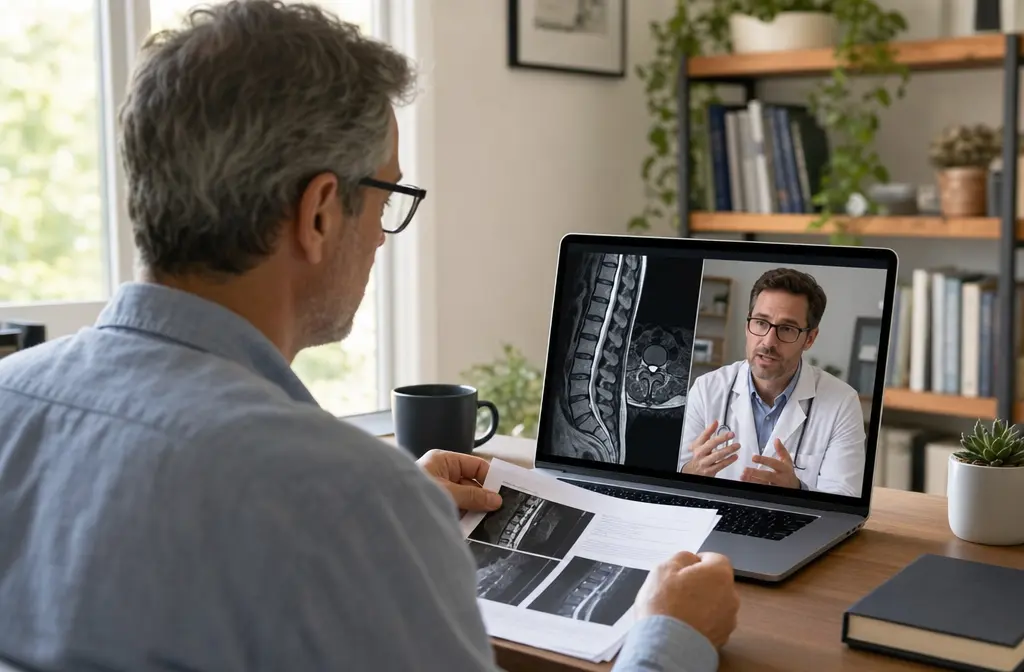
I offer online spine second opinions from Stolberg, Germany, to patients worldwide for exactly this reason. The goal isn't to overrule your local surgeon — it's to give you a clearer, calmer view of your own options before you commit to an operation you can't undo.
FAQ
Is artificial disc replacement reversible?
Not really. The original disc is removed during surgery. If the implant fails, the level is usually converted to a fusion rather than reverted to native anatomy.
Can I have an MRI after disc replacement?
Yes, modern artificial discs are generally MRI-compatible, though local artefact around the implant can limit image quality at that level.
Does disc replacement set off airport security?
The implant may occasionally trigger metal detectors. Carry your implant card or a brief letter from your surgeon when travelling.
Can ADR and fusion be combined in the same operation?
Yes — a "hybrid" construct (ADR at one level, fusion at another) is sometimes used when adjacent levels have different problems. It's a more specialised decision.
What if my surgeon only offers fusion?
That's a valid reason to get a second opinion. Many excellent surgeons specialise in one technique; it doesn't mean it's the only option for you.
How do I know if I really need surgery at all?
Many disc problems improve with time, physiotherapy, and targeted injections. A second opinion focused on whether surgery is necessary — not just which surgery — is often the most valuable conversation you can have.
Conclusion
Artificial disc replacement vs fusion isn't a contest with one winner. They're two tools for overlapping but distinct problems. ADR is excellent for the right patient: isolated disc disease, good bone, no instability, motion worth preserving. Fusion remains the workhorse for instability, deformity, and complex multi-level degeneration. Both can deliver meaningful improvement in well-selected cases, and both can disappoint when indications are stretched.
Practical next steps:
- Get a clear written diagnosis and a copy of your MRI on disc or upload link.
- Ask your surgeon specifically why they recommend ADR or fusion in your case.
- Consider an independent online second opinion before scheduling.
- Make sure non-surgical options have been genuinely explored if your symptoms allow.
This article is educational and not a substitute for an in-person evaluation. If you'd like a structured review of your imaging and options, an online second opinion is a calm, low-pressure place to start.